

What Are Commonwealth Law Reports? Meaning, Examples, and How to Use Them in Legal Research
If you are new to legal studies or legal research, you may come across the term Commonwealth Law Reports (CLR) in Australia and wonder what it actually means. Simply put, CLR is one of the key legal resources used to understand important court decisions from the High Court of Australia.

Legal materials often feel complex at first, but once broken down into simple language, they become much easier to understand. In essence, Commonwealth Law Reports bring together significant court judgments that help explain how laws are interpreted and applied in real cases.
In this guide, you will learn:
- What Commonwealth Law Reports are
- Why they are important
- How they are used in legal research
- Simple examples to understand them better
What Are Commonwealth Law Reports?
Simple Meaning
Commonwealth Law Reports (CLR) are the official, authorized collection of High Court decisions. These reports publish detailed records of important legal cases, including the facts, legal issues, judgments, and the reasoning given by judges.
What makes CLR especially important is that it is an authorized report series. This means the judgments are reviewed and approved by the judges themselves before publication, ensuring accuracy and making them one of the most trusted and reliable versions of a case.
The Commonwealth Law Reports have been publishing High Court decisions since 1903, giving them a long-standing history and strong authority in legal research and practice.
Key Features
- They contain important and officially reported High Court cases
- They include judges’ full decisions and legal reasoning
- They are authorized reports, reviewed before publication for accuracy
- They are highly authoritative and widely trusted in legal systems
- They are used as a reference in future court cases and legal research

In short
Commonwealth Law Reports help legal professionals understand how laws are interpreted and applied, and they are considered one of the most reliable sources for studying High Court decisions.
Why Are Commonwealth Law Reports Important?
Commonwealth Law Reports play a key role in legal systems that follow case law.
1. Help in Understanding Legal Principles
Each case explains how a law works in a real situation. This helps in understanding legal concepts more clearly and applying them in practice.
2. Used as Binding Precedents
Courts often follow previous decisions when handling similar cases. These decisions published in the Commonwealth Law Reports act as binding precedent, meaning they must be followed by all lower courts in Australia when similar legal issues arise.
3. Trusted Legal Source
CLR is considered an official and highly accurate source, making it reliable for legal research and citation in academic and professional work.
4. Essential for Lawyers and Students
- Lawyers use CLR to prepare strong legal arguments
- Judges rely on it when making court decisions
- Students use it to understand legal reasoning and case law development
Structure of a Commonwealth Law Report
Each Commonwealth Law Report follows a clear and structured format. Understanding these sections makes it much easier to read, interpret, and analyze legal cases—especially for beginners.
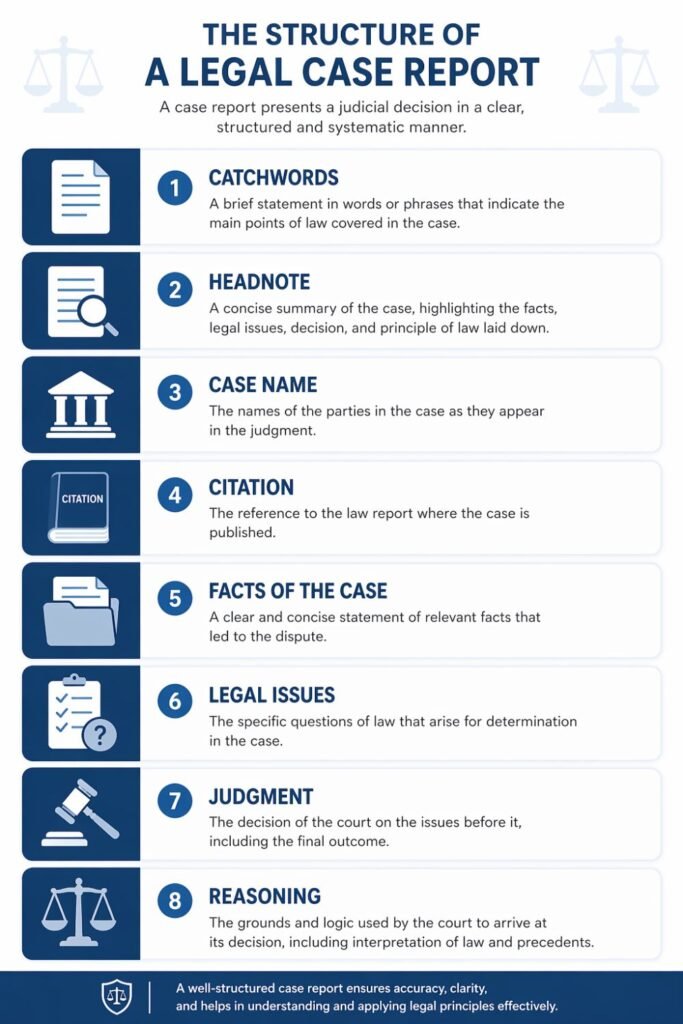
Catchwords
Catchwords are keywords placed at the top of the report. They highlight the main legal topics covered in the case and are mainly used for quick reference and indexing.
- Example: contract law, negligence, duty of care
Headnote
The headnote is a short summary written by the law reporter. It outlines the key facts, legal issues, and outcome of the case in simple language. Beginners often find this section helpful before reading the full judgment.
Case Name
This shows the names of the parties involved in the case.
- Example: Smith v Jones
Citation
A citation is a unique reference used to locate the case in law reports. It helps researchers and lawyers find the exact report quickly.
- Example: (2020) 250 CLR 123
Facts of the Case
This section explains what actually happened between the parties. It provides the background story of the legal dispute in a clear and brief way.
Legal Issues
These are the main legal questions the court needs to decide. This section helps identify what the dispute is really about from a legal point of view.
Judgment
This is the final decision of the court. It explains which party won the case and what legal outcome was reached.
Reasoning
This section explains why the judges reached their decision. It includes the legal principles, arguments, and analysis used to justify the outcome.
Examples of Commonwealth Law Reports
Let’s understand how Commonwealth Law Reports work by looking at real landmark cases. These examples show how courts actually use CLR in important legal decisions and how legal principles are applied in real-life situations.

Example 1: Contract Law Case
One well-known case reported in the Commonwealth Law Reports is:
Waltons Stores (Interstate) Ltd v Maher (1988) 164 CLR 387
In this case:
- A company (Waltons Stores) showed interest in leasing land
- The landowner started construction based on that understanding
- Later, the company changed its decision and refused to proceed with the deal
- The dispute went to court to decide whether the company could be held responsible even without a final signed contract
The CLR report includes:
- Background of the agreement between both parties
- Legal issue: whether promissory estoppel applied
- Final judgment: the court held Waltons Stores liable
This case is important because it expanded the idea of fairness in contract law and showed that legal responsibility can exist even without a formal contract in certain situations.
Example 2: Constitutional Law Case
A very famous case in Australian legal history is:
Mabo v Queensland (No 2) (1992) 175 CLR 1
In this case:
- Eddie Mabo and others challenged the legal concept that Australia was “terra nullius” (land belonging to no one)
- The case questioned the land ownership rights of Indigenous Australians
- The High Court had to decide whether Indigenous land rights could be legally recognized
The CLR report explains:
- Historical background of land ownership in Australia
- Legal issue: recognition of native title
- Final judgment: the court recognized native title rights for the first time
This case is one of the most important decisions in Australian constitutional and property law, as it changed the legal understanding of land ownership.
Example 3: Negligence Case
A landmark negligence case reported in the Commonwealth Law Reports is:
Wyong Shire Council v Shirt (1980) 146 CLR 40
In this case:
- A person was injured while using a water ski area marked by warning signs
- The case focused on whether the local council was responsible for the injury
- The court had to decide what level of care is required to avoid harm
The CLR report explains:
- What happened in the incident
- Whether the council owed a duty of care
- Whether that duty was breached by failing to provide adequate warnings
- The reasoning used by the court to reach its decision
This case is important because it helped define how courts assess the concept of “foreseeable risk” in negligence law.
Why These Real Cases Matter
Using real cases instead of generic examples helps you:
- Understand actual legal reasoning used by courts
- See how laws are applied in real disputes
- Improve accuracy in legal research
- Build stronger academic and professional understanding
Real CLR cases are essential because they show not just what the law is, but how the law works in practice.
How to Use Commonwealth Law Reports in Legal Research
Using Commonwealth Law Reports (CLR) effectively is an important skill for legal research. These reports help you understand real court decisions and apply them to your own legal work.
Where to Find Commonwealth Law Reports
Before using them, you need to know where to access CLR:
- University libraries (law libraries often keep printed and digital versions)
- Online legal databases, such as:
- Westlaw
- LexisNexis
- Jade (legal database used for case law research)
These platforms allow you to search cases by keywords, case name, or citation, making research faster and more efficient.
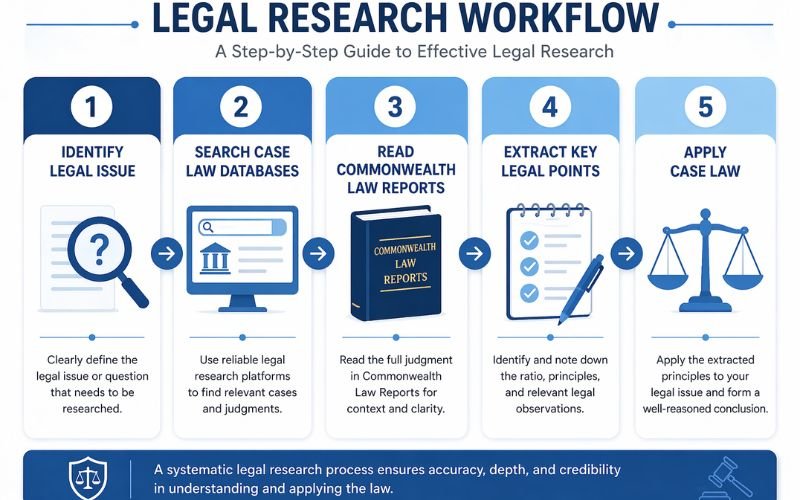
Step 1: Identify Your Legal Issue
Start by clearly understanding the legal question you are trying to solve.
Example: What is negligence in law?
This step helps you focus your search and avoid irrelevant cases.
Step 2: Search for Relevant Cases
Use CLR sources or legal databases to find cases related to your topic.
- Enter keywords (e.g., “negligence,” “contract breach”)
- Filter results by relevance or date
- Select cases that closely match your legal issue
Step 3: Read the Case Carefully
Once you find a case, read it thoroughly. Focus on the key parts:
- Facts of the case
- Legal issue being discussed
- Court’s judgment
- Reasoning behind the decision
Understanding these elements is important for proper legal interpretation.
Step 4: Extract Key Points
While reading, take clear and structured notes such as:
- Important legal principles established in the case
- How the court applied the law
- Final decision and its significance
These notes will help you during assignments, essays, or case analysis.
Step 5: Apply the Case to Your Work
Finally, use the case to support your legal argument or research.
- Compare it with your legal issue
- Use it as a precedent (if relevant)
- Support your conclusions with case law
This shows strong legal reasoning and improves the quality of your work.
How to Cite Commonwealth Law Reports
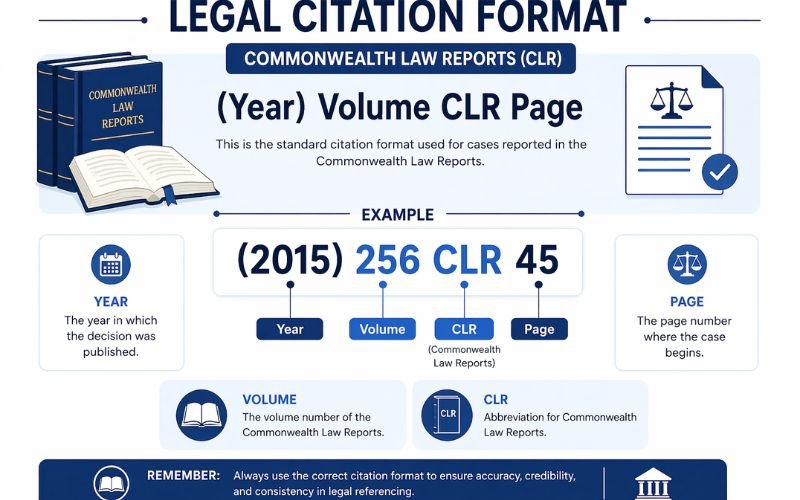
Citing cases correctly is important in legal writing. It helps readers quickly locate the exact case being referenced and ensures academic and legal accuracy.
Basic Format
(Year) Volume CLR Page
Example
(2015) 256 CLR 45
Understanding the Citation Format
- Year → When the case was reported
- Volume → Book number in which the case appears
- CLR → Commonwealth Law Reports
- Page → Starting page of the case
Important Note: Square Brackets vs Round Brackets
In legal citations, the type of brackets used is also important:
- Round brackets ( ) → The year is not essential for finding the volume. The report series is organized in a way that volume numbers are enough.
- Example: (2015) 256 CLR 45
- Square brackets [ ] → The year is essential to locate the correct volume because volumes are organized by year.
- Example: [2015] 3 CLR 120
Key Takeaway
Always pay attention to the bracket style because it tells you how the law report is organized and how to locate the case correctly.
Difference Between CLR and Other Law Reports
Many beginners get confused when comparing different types of law reports, especially when deciding which source to use for legal writing or court citations. Understanding these differences helps in selecting the most reliable and appropriate legal reference for research and practice.
Comparison: Commonwealth Law Reports (CLR) vs Australian Law Reports (ALR)
Comparison of Commonwealth Law Reports (CLR) and Australian Law Reports (ALR)\text{Comparison of Commonwealth Law Reports (CLR) and Australian Law Reports (ALR)}Comparison of Commonwealth Law Reports (CLR) and Australian Law Reports (ALR)
| Feature | Commonwealth Law Reports (CLR) |
Australian Law Reports (ALR)
|
| Status | Officially authorized law reports |
Unofficial law reports
|
| Publisher | Official record of High Court decisions |
Published by commercial legal publishers
|
| Authority | Highly authoritative and widely accepted in courts |
Secondary reference source
|
| Citation in Court | Must be cited when available |
Used only if CLR is not available
|
| Scope | Focus on landmark and precedent-setting cases |
Covers a broader range of cases, including less significant ones
|
| Publication Speed | Slower but officially verified |
Faster publication but not an official record
|
Key Practical Difference
If a case is reported in both Commonwealth Law Reports (CLR) and Australian Law Reports (ALR), legal professionals and courts always prefer CLR because it is the official and most authoritative source.
- CLR is used for formal legal citation and court references
- ALR is useful for early research and case reading, but not preferred for final citation
Summary
- CLR = Official, authoritative, and must-cite source in court
- ALR = Secondary source, useful for research, but not preferred when CLR is available
Common Mistakes and Best Practices for Beginners
When using Commonwealth Law Reports, beginners often make a few common mistakes. Understanding these early can help improve legal research skills and make analysis more accurate and reliable.
Common Mistakes to Avoid
- Reading only the summary and skipping the full judgment
- Not clearly understanding the main legal issue in the case
- Using outdated cases without checking whether they are still relevant
- Writing incorrect citation formats
- Confusing High Court of Australia cases in Commonwealth Law Reports with decisions from lower state courts or courts from other countries like the UK
Each court system works differently, and mixing them up can lead to incorrect legal understanding.
Best Practices for Beginners
- Always read the case carefully from start to finish, including facts, reasoning, and judgment
- Focus on identifying the main legal issue before studying the outcome
- Double-check whether the case is still relevant before using it in research or assignments
- Ensure citations follow the correct format used in legal writing
- Take notes while reading to clearly understand key legal principles
Key Tip
A careful and structured approach makes legal research more accurate and reliable. Instead of rushing through cases, take time to understand how judges reached their decisions and what legal principles were applied.
Tips for Beginners
If you are just starting, these tips will help you:
- Start with simple cases
- Focus on understanding the reasoning
- Use legal dictionaries for difficult terms
- Practice case summaries
- Take notes while reading
Conclusion
Commonwealth Law Reports are an important resource in the legal field, especially in Australia and other Commonwealth jurisdictions. They provide official and detailed records of significant court decisions, helping readers understand how laws are interpreted and applied in real situations.
For beginners, reading and using CLR may feel difficult at first. However, with regular practice, it becomes much easier. By learning the structure of cases, carefully reviewing judgments, and focusing on the reasoning behind decisions, you can gradually build strong legal research skills and improve your understanding of law.
FAQs
1. What are Commonwealth Law Reports in simple terms?
They are official published records of important court decisions, mainly from higher courts in Australia, used for legal reference and research.
2. Who uses Commonwealth Law Reports?
Lawyers, judges, law students, and legal researchers commonly use them to study case law and support legal arguments.
3. Why are CLR important?
They explain how legal principles are applied in real cases and are often used as precedents for future court decisions.
4. How do I read a Commonwealth Law Report?
Focus on the key sections:
- Facts of the case
- Legal issues
- Court judgment
- Reasoning behind the decision
5. Are Commonwealth Law Reports difficult for beginners?
They may seem complex initially, but with consistent practice and a step-by-step approach, they become easier to understand.
6. Can I access Commonwealth Law Reports for free?
Yes, some case summaries and judgments are available for free through public legal resources. One useful platform is the Jade database, which provides access to a wide range of Australian case law. However, full official reports are often available through paid legal databases or university libraries.
7. What does CLR stand for in law?
In the context of Australian law, CLR stands for Commonwealth Law Reports, which are the authorized reports of the High Court of Australia.