
How Long Is Law School? (2026 Complete Timeline + Global Comparison Guide)
Quick Answer
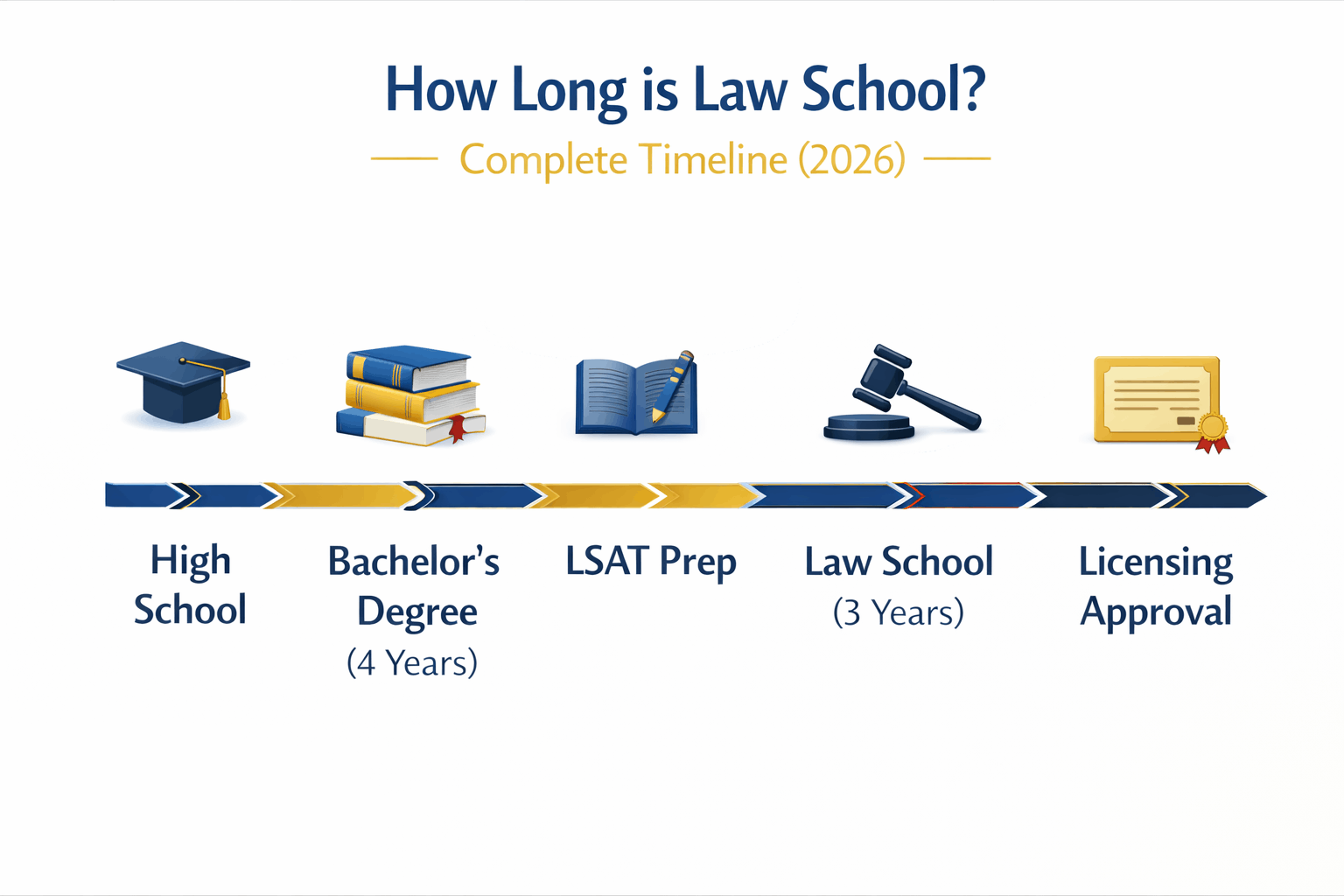
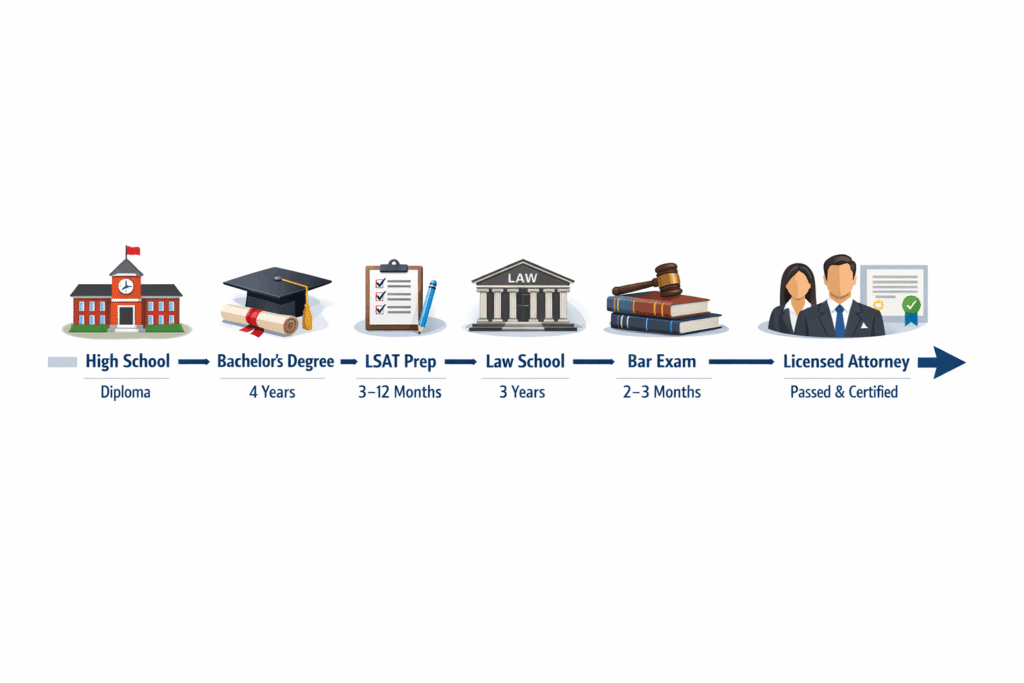
Law school in the United States typically takes 3 years full-time or 4 years part-time. However, when you include a 4-year bachelor’s degree, LSAT preparation, bar exam preparation, and licensing approval, the full journey to becoming a licensed lawyer usually takes 7–8 years.
Complete Timeline: From High School to Licensed Lawyer
Becoming a lawyer involves multiple stages beyond law school itself.
1 Bachelor’s Degree – 4 Years
In the U.S., law is a graduate-level degree. Students must first complete a 4-year undergraduate program. There is no required major, but common choices include:
- Political Science
- History
- Economics
- Business
- English
A strong undergraduate GPA significantly improves law school admission chances.
2 LSAT Preparation – 3 to 12 Months
Most applicants spend several months preparing for the LSAT.
- Average preparation: 4–6 months
- Intensive prep: 300+ study hours
- Retakes can delay enrollment by a year
Your LSAT score plays a major role in admission and scholarship opportunities.
3 Law School (Juris Doctor) – 3 Years
This is the standard full-time duration.
Year 1 (1L): Core legal foundations
Year 2 (2L): Specialization & internships
Year 3 (3L): Practical training & job search
Part-time programs typically extend this to 4 years.
Students often dedicate full-time effort to coursework, reading, internships, and career preparation.
4 Bar Exam Preparation – 2 to 3 Months
After graduation, most students complete:
- 8–10 weeks of structured bar preparation
- 400–600 hours of focused study
If a candidate does not pass, retaking the exam may add 6–12 months to the licensing timeline.
5 Licensing & Character Review – 3 to 6 Months
Before officially practicing law, candidates must complete:
- Background checks
- Character & fitness review
- Oath ceremony
Processing times vary by state.
Total Estimated Time
| Stage | Estimated Time |
| Bachelor’s Degree | 4 Years |
| LSAT Prep | 3–12 Months |
| Law School | 3 Years |
| Bar Prep | 2–3 Months |
| Licensing Approval | 3–6 Months |
Realistic Total: 7–8 Years
With delays, the process may extend to 8–9 years.
Law School Year-by-Year Breakdown
Understanding what happens during each year provides a clearer picture of the academic journey.
1L (First Year)
The first year builds foundational legal reasoning skills.
Core subjects typically include:
- Contracts
- Torts
- Civil Procedure
- Criminal Law
- Constitutional Law
- Legal Research & Writing
The academic workload is demanding, requiring disciplined time management and strong analytical skills.
2L (Second Year)
Students begin shaping their legal focus.
Common activities include:
- Selecting electives (Corporate Law, IP, Criminal Procedure, etc.)
- Securing summer internships
- Participating in law review or moot court
Summer internships after 2L often influence post-graduation job opportunities.
3L (Final Year)
The final year emphasizes practical experience and employment preparation.
Students may participate in:
- Legal clinics
- Trial advocacy programs
- Judicial externships
Many students secure employment offers before graduation.

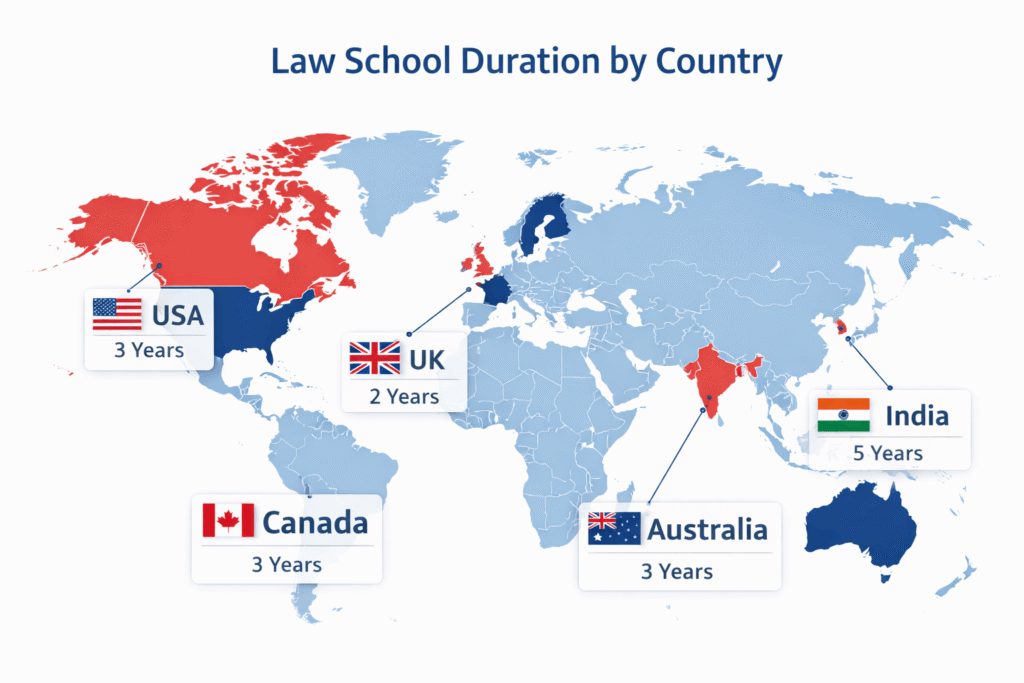
How Long Is Law School in Different Countries?
Law degree structures vary internationally.
| Country | Structure | Time After High School |
| United States | 4-year bachelor’s + 3-year JD | 7 years |
| United Kingdom | 3-year LLB | 3 years |
| Canada | 4-year bachelor’s + 3-year JD | 7 years |
| Australia | 4-year LLB OR 3-year JD | 4 –7 years |
| India | 5-year integrated OR 3-year LLB | 3–5 years |
Some countries allow students to begin legal studies directly after high school, shortening the total academic timeline.
Can You Finish Law School Faster?
Certain pathways may reduce completion time.
Accelerated JD Programs (2 Years)
- Year-round coursework
- Intensive schedule
- Limited academic breaks
Dual Degrees (JD + MBA, etc.)
- Combine two degrees efficiently
- Usually completed in 4 years instead of 5
Summer Courses
- Reduce regular semester load
- May allow earlier completion
Credit Transfers
- Possible when transferring between accredited institutions
- Approval varies by school
Pros & Cons of Accelerating
| Option | Pros | Cons |
| Accelerated JD | Enter workforce sooner | Heavy workload |
| Dual Degree | Time-efficient dual credentials | Increased tuition & pressure |
| Summer Courses | Flexible acceleration | Burnout risk |
| Credit Transfer | Fewer required semesters | Not always approved |
Finishing faster can be beneficial, but workload intensity and career planning should be considered carefully.

Part-Time vs Full-Time Law School
| Factor | Full-Time | Part-Time |
| Duration | 3 Years | 4 Years |
| Flexibility | Low | High |
| Schedule | Daytime | Evenings / Weekends |
| Work While Studying | Limited | More feasible |
| Best For | Traditional students | Working professionals |
Both paths lead to the same JD degree. The best choice depends on financial situation, lifestyle, and career goals.
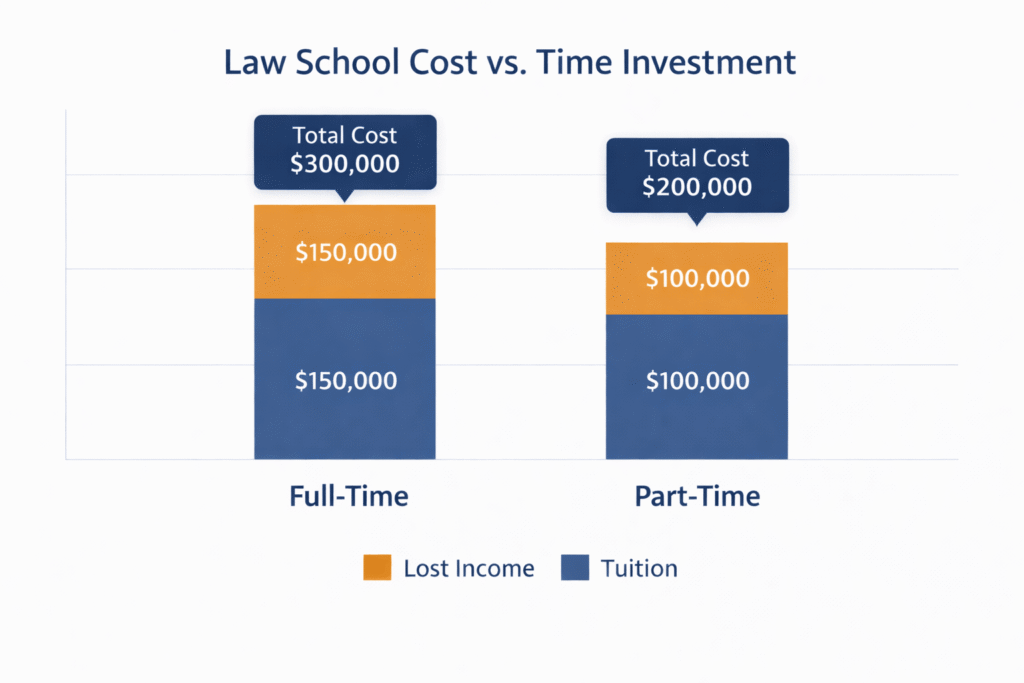
Cost vs Time Investment
Law school represents a major financial commitment.
Estimated Tuition (Per Year)
- Public (in-state): $25,000–$35,000
- Private: $50,000–$70,000
Over three years, tuition alone may range from $90,000 to $200,000+, excluding living expenses.
Opportunity Cost
If a graduate could earn $45,000 annually, three years of lost income equals $135,000.
Total economic impact may exceed $250,000–$400,000, depending on school type and living costs.
Return on investment depends on:
- School reputation
- Practice area
- Geographic location
- Debt level

What Can Delay Law School Graduation?
Potential delays include:
- Academic probation
- Failed courses
- Personal or medical leave
- Switching to part-time enrollment
- Bar exam retakes (post-graduation delay)
Planning for contingencies helps reduce timeline disruptions.
Frequently Asked Questions
Is law school harder than college?
Yes. Law school typically involves heavier reading loads, competitive grading curves, and rigorous analytical training compared to undergraduate study.
Can you work while in law school?
Part-time students often work full-time. Full-time students may work limited hours, but balancing employment with academic demands can be challenging.
How long is law school in Texas or California?
In both states, law school typically takes 3 years full-time or 4 years part-time, followed by bar exam and licensing requirements.
Does specialization change the timeline?
No. Choosing a field like criminal or corporate law does not extend the standard 3-year JD program.
Do online law schools take longer?
Most follow a 3–4 year structure. Completion time depends on whether the program is full-time or part-time.
Final Summary
Law school itself typically takes 3 years full-time.
However, the full path to becoming a licensed attorney — including undergraduate education, entrance exams, bar preparation, and licensing approval — usually spans 7–8 years.
Before applying, carefully consider:
- Academic commitment
- Financial investment
- Long-term career goals
With preparation and realistic expectations, the journey to becoming a lawyer is demanding — but entirely achievable.