

Lawyer vs Attorney: What Is the Difference? (Complete Guide 2026)
Introduction
What is the difference between a lawyer and an attorney?
A lawyer is someone who has completed a law degree and understands the legal system, while an attorney is a lawyer who has passed the bar exam and is legally licensed to represent clients in court. In simple terms, all attorneys are lawyers, but not all lawyers are attorneys.
The terms lawyer and attorney are often used interchangeably, which is why many people feel confused about their actual meaning. When searching for legal help or exploring legal careers, you may frequently see both words used to describe legal professionals. Although they are closely related, they are not always exactly the same. Understanding the difference between a lawyer and an attorney can help you choose the right professional for your legal needs.
In general, both lawyers and attorneys study law and have strong knowledge of legal systems and regulations. However, their roles can differ depending on professional qualifications, licensing requirements, and the legal system of a particular country. In the United States, for example, the distinction usually depends on whether a person has passed the bar exam and is authorized to practice law in court.
Short Answer
A lawyer is someone who has studied law and earned a law degree, while an attorney (or attorney-at-law) is a lawyer who has passed the bar exam and is licensed to represent clients in court.
Simple Explanation
- All attorneys are lawyers because they have completed legal education.
- However, not all lawyers are attorneys because some law graduates may not pass the bar exam or obtain a license to practice law in court.
Because of these subtle differences, it is important to understand how each role functions within the legal system. In the following sections, we will explore what lawyers and attorneys do, their qualifications, and the key differences between them.
What Is a Lawyer?
Definition of a Lawyer
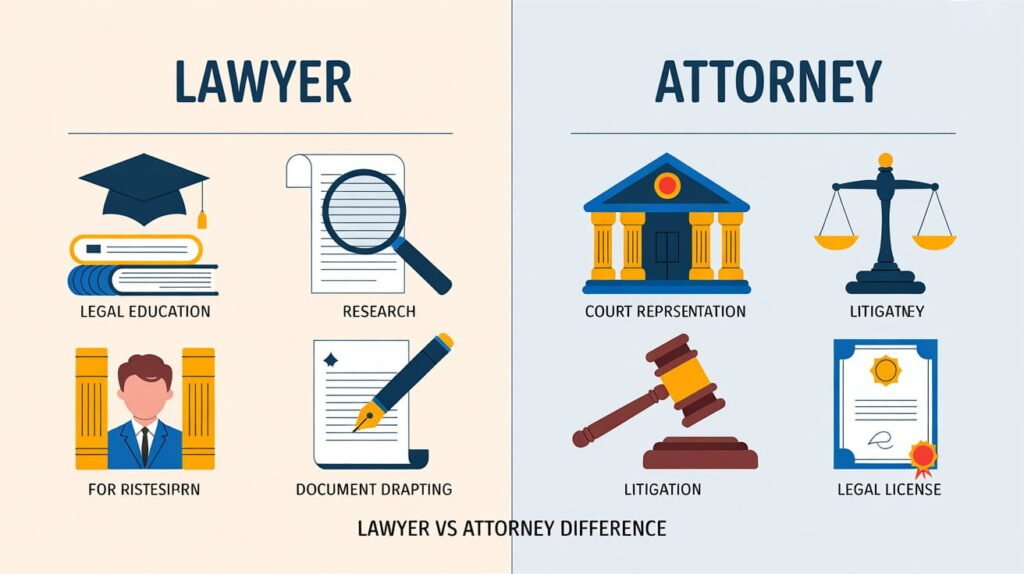
A lawyer is a trained legal professional who has completed a law degree and has a deep understanding of the legal system. Lawyers are qualified to provide legal advice, interpret laws and regulations, and assist individuals, businesses, or organizations with various legal matters.
The primary role of a lawyer is to help clients understand their legal rights, responsibilities, and legal options. They analyze legal problems, conduct research, interpret laws, and offer guidance on the best possible solutions. Lawyers also help clients navigate complex legal procedures, ensuring that their actions comply with applicable laws and regulations.
In many cases, lawyers assist with drafting legal documents, reviewing contracts, and providing consultations for legal disputes or business decisions. However, depending on the jurisdiction, a lawyer may not always represent clients in court unless they pass the bar examination and obtain the required legal license.

Types of Lawyers
Lawyers often specialize in different areas of law depending on their education, experience, and professional interests. Each type of lawyer focuses on a specific category of legal issues and provides specialized legal services.
Some of the most common types of lawyers include:
Corporate Lawyer
Corporate lawyers handle legal matters related to businesses and companies. They assist with mergers, acquisitions, corporate governance, contracts, and regulatory compliance.
Criminal Defense Lawyer
Criminal defense lawyers represent individuals or organizations accused of committing crimes. Their role includes defending clients in court, negotiating plea deals, and ensuring that the legal rights of the accused are protected.
Family Lawyer
Family lawyers deal with legal issues related to family relationships, such as divorce, child custody, adoption, alimony, and domestic disputes. They help resolve sensitive legal matters that affect families and personal relationships.
Intellectual Property Lawyer
Intellectual property lawyers protect creations of the mind, including inventions, trademarks, copyrights, and patents. They help businesses and individuals secure legal rights over their innovations and creative works.
By specializing in different areas of law, lawyers can provide more focused expertise and tailored legal solutions for specific types of legal problems.
Education Required to Become a Lawyer
Becoming a lawyer typically requires formal legal education and professional training. Although the exact process can vary depending on the country, most legal professionals follow a similar path that includes completing a law degree, gaining practical experience, and sometimes specializing in a particular area of law.
Earn a Law Degree
The first step to becoming a lawyer is earning a law degree from a recognized law school. The most common degrees include a Juris Doctor (JD) in the United States or a Bachelor of Laws (LLB) in many other countries. These programs teach essential legal subjects such as constitutional law, criminal law, contracts, legal writing, and civil procedure.
Below is a simple comparison of common law degrees in different countries:
| Country | Common Law Degree |
| United States | Juris Doctor (JD) |
| United Kingdom | Bachelor of Laws (LLB) |
| India | Bachelor of Laws (LLB) |
| Canada | Juris Doctor (JD) or LLB |
This legal education provides the foundation for understanding legal systems, interpreting laws, and advising clients on legal matters.
Legal Training or Internship
After or during law school, many aspiring lawyers gain practical experience through internships, clerkships, or legal training programs. These opportunities allow students to work with experienced legal professionals, develop research skills, draft legal documents, and observe real court proceedings.
Specialization
Some lawyers choose to specialize in specific areas of law depending on their interests and career goals. Common specializations include corporate law, criminal law, family law, intellectual property law, and immigration law. Specialization can help lawyers build expertise and improve career opportunities in particular legal fields.
In some countries, completing a law degree allows a person to be referred to as a lawyer. However, additional licensing or professional certification may still be required before they can officially practice law or represent clients in court.
Responsibilities of a Lawyer
Lawyers perform a wide range of tasks depending on their area of expertise and the legal needs of their clients. Their primary responsibility is to provide professional legal guidance, protect the rights of their clients, and ensure that individuals or businesses follow applicable laws and regulations.
In many situations, lawyers help clients understand complex legal processes and make informed decisions before legal disputes arise. Their work often involves analyzing legal issues, preparing documentation, and offering strategic advice to prevent potential legal problems.
Common responsibilities of a lawyer include:
Providing Legal Advice – Lawyers guide clients on their legal rights, responsibilities, and possible outcomes related to a legal matter. This advice can help individuals and businesses make informed decisions.
Conducting Legal Research – Lawyers analyze statutes, regulations, and previous court decisions to build legal arguments and provide accurate legal guidance.
Drafting Legal Documents – Lawyers prepare essential legal documents such as contracts, agreements, wills, legal notices, and compliance policies to ensure they meet legal standards.
Reviewing Legal Documents – Lawyers carefully examine contracts, agreements, and other legal paperwork to identify risks, protect client interests, and ensure the documents are legally enforceable.
Negotiating Settlements – In many disputes, lawyers negotiate with opposing parties to reach a settlement that resolves the issue without the need for lengthy court proceedings.
Representing Clients in Mediation – Lawyers may assist clients during mediation or alternative dispute resolution processes where both parties attempt to settle a disagreement outside of court.
Advising Businesses on Legal Compliance – Many lawyers help companies follow laws and regulations related to employment, contracts, taxes, and corporate governance.
Offering Legal Consultation – Lawyers meet with clients to discuss legal concerns, analyze potential risks, and recommend the most appropriate legal strategy.
For example, a business owner may consult a lawyer to review a partnership agreement and ensure it complies with corporate laws. Similarly, an individual might seek legal advice before signing an important contract or making a significant financial decision. In both cases, a lawyer’s expertise helps prevent legal disputes and ensures that all actions follow the law.
What Is an Attorney?
An attorney, also known as an attorney-at-law, is a legal professional who is licensed to practice law and represent clients in court. While all attorneys are trained in law, they must also pass a bar examination and obtain an official legal license before they can legally practice law and act on behalf of clients in legal matters.
The word “attorney” originates from the Old French term atorné, which means a person appointed to act on behalf of another. In the legal system, this meaning reflects the core responsibility of an attorney—to represent and advocate for clients in legal proceedings.
In simple terms, an attorney is a lawyer who has the legal authority to represent individuals, businesses, or organizations in court proceedings and legal disputes. This professional licensing is what distinguishes attorneys from individuals who have simply studied law but are not authorized to practice it.
Attorneys play a vital role in the legal system by advising clients, resolving disputes, protecting legal rights, and representing clients during litigation. Their work helps ensure that the legal process operates fairly and that individuals receive proper legal representation when dealing with complex legal issues.

Attorney’s Role in the Legal System
Attorneys serve as legal representatives and advocates for their clients. They guide individuals and organizations through legal processes while ensuring that laws are applied correctly and fairly.
Some of the key responsibilities of an attorney include:
- Providing professional legal advice on legal rights and obligations
- Representing clients in civil and criminal court cases
- Preparing legal strategies for disputes or litigation
- Negotiating settlements between parties involved in legal conflicts
- Drafting and reviewing legal contracts and court documents
- Filing legal motions, appeals, and lawsuits on behalf of clients
Because attorneys are licensed professionals, they must follow strict ethical standards and professional regulations while practicing law.
What Attorneys Can Do That Lawyers Cannot
Although the terms lawyer and attorney are often used interchangeably, the primary difference lies in licensing and court representation. An attorney has the legal authority to represent clients in court and manage official legal proceedings.
Attorneys can perform several responsibilities that not all lawyers are authorized to do, including:
- Represent clients in court proceedings before a judge or jury
- Handle litigation cases, including civil disputes and criminal defense
- File lawsuits and other legal actions in the court system
- Submit official legal documents, such as motions, appeals, and legal petitions
- Act as a legal representative for clients in formal legal matters
These responsibilities require passing the bar exam and obtaining a legal license to practice law in a specific jurisdiction.
Examples of an Attorney’s Work
To better understand the role of an attorney, consider the following real-life examples.
Court Representation
If a person is facing criminal charges, an attorney can represent them in court, defend their case, present evidence, and argue before a judge or jury.
Handling Litigation
In a business dispute, an attorney manages the litigation process, including filing the lawsuit, preparing legal arguments, and negotiating a settlement.
Filing Legal Actions
When someone files a lawsuit for personal injury or breach of contract, an attorney prepares and submits the legal documents required to initiate the legal case.
Key Differences Between a Lawyer and an Attorney
Although the terms lawyer and attorney are often used interchangeably, they are not exactly the same. Both professionals study law and have a strong understanding of legal systems, but their authority and professional responsibilities can differ depending on licensing and qualifications.
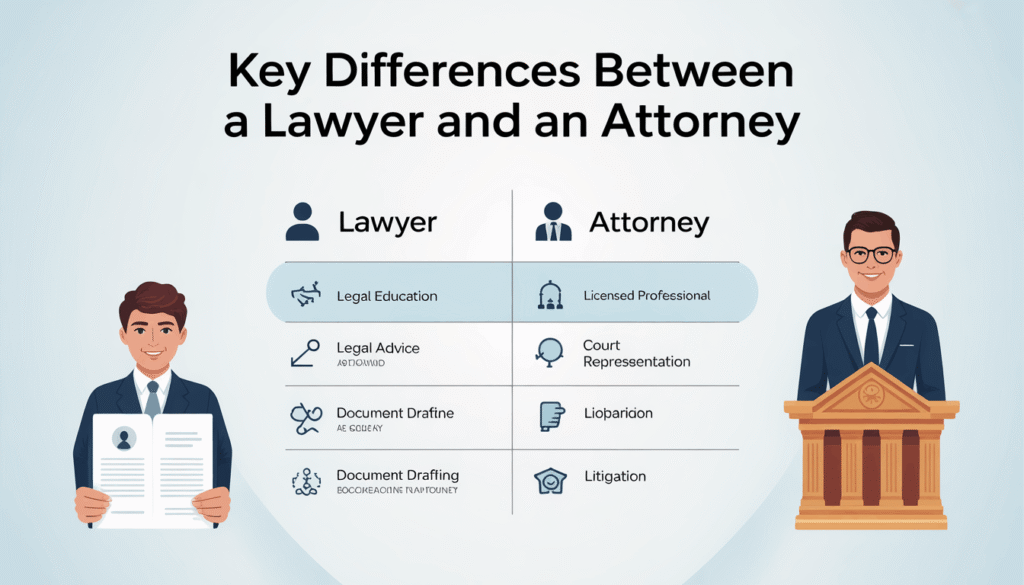
In general, a lawyer is someone who has completed legal education and obtained a law degree, such as a Juris Doctor (JD) or Bachelor of Laws (LLB). An attorney, also known as an attorney-at-law, is a lawyer who has passed the bar examination and obtained a legal license to represent clients in court.
In simple terms, all attorneys are lawyers, but not all lawyers are attorneys. The key distinction is that attorneys are legally authorized to practice law in court and represent clients in formal legal proceedings.
The table below summarizes the major differences between a lawyer and an attorney.
| Feature | Lawyer | Attorney |
| Law Degree | Required (JD or LLB) | Required (JD or LLB) |
| Bar Examination | Not always required | Must pass the bar exam |
| License to Practice | May not always require a license depending on role | Mandatory legal license |
| Court Representation | May not represent clients in court | Authorized to represent clients in court |
| Legal Advice | Can provide legal advice and consultation | Can provide legal advice and full legal representation |
| Litigation | Usually limited involvement | Can handle lawsuits and litigation |
| Professional Title | Broad term for legal professionals | Licensed legal practitioner |
Quick Summary
To simplify the difference:
- A lawyer is anyone who has completed legal education and has knowledge of the law.
- An attorney is a lawyer who has passed the bar exam and is licensed to practice law in court.
- All attorneys are lawyers, but not all lawyers are attorneys.
Understanding this distinction helps individuals and businesses choose the right legal professional depending on their needs—whether they require legal advice, document preparation, or formal representation in court.
Real-Life Examples of Lawyer vs Attorney
Understanding the difference between a lawyer and an attorney becomes much clearer when we look at real-world situations. While both professionals have legal education and can provide legal guidance, the key difference often lies in whether they are licensed to represent clients in court. The following examples illustrate how their roles may differ in practical legal scenarios.
Example 1: Business Contract
Imagine a small business owner who wants to draft a partnership agreement for a new startup. In this situation, the business owner may hire a lawyer to review the contract, provide legal advice, and ensure that the agreement complies with relevant laws. The lawyer can help identify potential risks, suggest better contract terms, and protect the interests of the business.
However, if a dispute later arises between the partners and the case goes to court, the business owner would need an attorney who is licensed to represent clients in legal proceedings. The attorney can file legal documents, present arguments before a judge, and defend the client’s interests during litigation.
Example 2: Criminal Case
Consider a person who has been accused of committing a crime. In this situation, legal representation becomes extremely important. A lawyer may initially provide legal advice, explain the charges, and help the individual understand their legal rights and possible options.
When the case moves into the courtroom, an attorney takes on the responsibility of representing the accused person before the court. The attorney can present evidence, question witnesses, negotiate plea agreements, and argue the case before the judge or jury in order to defend the client.
Example 3: Divorce Case
In a divorce situation, an individual may first consult a lawyer for legal guidance regarding property division, child custody, and financial responsibilities. The lawyer can explain the legal process, review important documents, and help prepare agreements between the spouses.
If the divorce becomes contested and requires court intervention, an attorney will represent the client in family court. The attorney can submit legal filings, present arguments to the judge, and advocate for the client’s interests related to custody arrangements, alimony, or division of assets.
Example 4: Personal Injury Case
Consider a situation where someone is injured in a car accident and wants to seek compensation for medical expenses and damages. Initially, the injured person may consult a lawyer to evaluate the case, review medical records, and provide legal advice about the available options.
However, if the case turns into a lawsuit and goes to court, an attorney will represent the injured person throughout the litigation process. The attorney can file the lawsuit, gather evidence, negotiate with insurance companies, and present the case before a judge or jury to secure fair compensation.
Summary
These real-life examples demonstrate how lawyers and attorneys may perform different roles depending on the legal situation. Lawyers often focus on providing legal advice, conducting research, and preparing legal documents, while attorneys have the additional authority to represent clients in court and manage formal legal proceedings.
Lawyer vs Attorney in Different Countries
The terms lawyer and attorney are often used interchangeably, but their meaning and usage can vary depending on the country and legal system. Each nation has its own legal structure and professional titles for individuals who practice law. In some countries, the term attorney is commonly used for licensed legal professionals who represent clients in court, while in others, titles such as advocate, solicitor, or barrister are more widely used.
Understanding these differences helps clarify why there is often confusion between the terms lawyer and attorney. Below is a breakdown of how these legal titles are used in different countries.
United States
In the United States, both lawyer and attorney generally refer to individuals who have completed law school. However, the term attorney (or attorney-at-law) specifically refers to a lawyer who has passed the state bar examination and is officially licensed to practice law and represent clients in court.
A person may complete a Juris Doctor (JD) degree and possess legal knowledge, but without passing the bar exam, they may not be authorized to practice law in court. This is why the common phrase “all attorneys are lawyers, but not all lawyers are attorneys” is frequently used in the U.S. legal system.
United Kingdom
In the United Kingdom, the terms lawyer and attorney are not used in the same way as in the United States. Instead, the legal profession is divided into two primary roles: solicitors and barristers.
- Solicitors usually provide legal advice, prepare legal documents, and communicate directly with clients.
- Barristers specialize in courtroom advocacy and represent clients during trials and court hearings.
In everyday language, the term lawyer is often used informally to refer to both solicitors and barristers.
India
In India, the most commonly used professional title for a licensed legal practitioner is advocate. After completing a law degree, individuals must register with the Bar Council of India and pass the required examinations to practice law.
While the word lawyer may sometimes be used informally to describe someone with legal education, advocate is the official designation for professionals who are legally authorized to represent clients in court.
Canada
In Canada, the term lawyer is widely used for licensed legal professionals. Similar to the United States, individuals must complete legal education and pass the required licensing process before they can practice law.
In many Canadian provinces, lawyers may perform responsibilities similar to both solicitors and barristers, meaning they can provide legal advice, prepare documents, and also represent clients in court.
Australia
In Australia, the term lawyer is commonly used as a general description for legal professionals. However, the legal profession is typically divided into two roles: solicitors and barristers, similar to the system used in the United Kingdom.
- Solicitors usually handle legal advice, contracts, and communication with clients.
- Barristers focus mainly on courtroom advocacy and representing clients in complex legal cases.
Because of this structure, the term lawyer in Australia often serves as a broad term that includes both solicitors and barristers.
Summary
As seen above, the terms lawyer, attorney, advocate, solicitor, and barrister may refer to similar legal professionals, but their exact meaning varies depending on the country’s legal system. Understanding these differences helps clarify why the terminology can be confusing, especially when comparing legal professions across different parts of the world.
Lawyer vs Attorney Salary Comparison
The salaries of lawyers and attorneys can vary significantly depending on factors such as country, level of experience, specialization, and the type of law firm or organization they work for. In many situations, the terms lawyer and attorney are used interchangeably, so their earning potential is often similar. However, attorneys who actively represent clients in court or specialize in high-demand legal fields may earn higher salaries.
Below is a quick overview of the average lawyer and attorney salaries in different countries.
| Country | Average Annual Salary |
| United States | $130,000 |
| United Kingdom | £50,000 – £70,000 |
| Canada | $90,000 – $100,000 |
| India | ₹6,00,000 – ₹12,00,000 |
These figures are averages and can vary depending on experience, location, and legal specialization.
Average Salary in the United States
The legal profession in the United States is known for offering some of the highest salaries in the world. On average, attorneys in the U.S. earn around $130,000 per year, although actual earnings vary widely depending on experience and practice area.
Typical salary ranges include:
- Entry-level lawyers: $70,000 – $98,000 per year
- Mid-career attorneys: $100,000 – $150,000 per year
- Experienced attorneys: $150,000 – $230,000+ per year
Lawyers working in specialized areas such as corporate law, intellectual property law, or mergers and acquisitions often earn significantly higher salaries, particularly in major cities like New York or California.
Salary in the United Kingdom
In the United Kingdom, legal professionals are usually referred to as solicitors or barristers, but their roles are comparable to lawyers and attorneys in other legal systems.
Typical salary ranges include:
- Average salary: £40,000 – £70,000 per year
- Experienced lawyers: £80,000 – £120,000+
- Top law firms in London: £120,000+ in some cases
Salaries are generally higher in major legal hubs such as London, especially for lawyers working in international law firms or corporate legal departments.
Salary in India
In India, the income of a lawyer or advocate can vary greatly depending on experience, reputation, and whether they work independently or in a law firm.
Typical salary ranges include:
- Entry-level lawyers: ₹3,00,000 – ₹6,00,000 per year
- Mid-level lawyers: ₹6,00,000 – ₹12,00,000 per year
- Experienced or corporate lawyers: ₹12,00,000 – ₹25,00,000+ per year
Corporate lawyers, legal advisors, and partners in large law firms often earn significantly higher salaries compared to independent advocates.
Factors That Affect Lawyer and Attorney Salaries
Several factors influence how much lawyers and attorneys earn in different regions and legal markets:
- Level of experience
- Area of specialization (corporate law, criminal law, intellectual property, etc.)
- Location and country
- Size and reputation of the law firm
- Client base and case complexity
For example, lawyers specializing in corporate law or mergers and acquisitions generally earn higher salaries than those working in public interest law or small local practices.
When Should You Hire a Lawyer vs an Attorney?
Understanding the difference between a lawyer and an attorney becomes especially important when you need legal help. Although both professionals have legal education and knowledge of the law, the type of assistance you require often determines which one is the right choice.
In many situations, a lawyer can provide legal guidance, research, and document preparation. However, when legal matters involve court proceedings or litigation, an attorney is typically required because they are licensed to represent clients in court.
Quick Decision Guide
Hire a lawyer if you need:
- Legal advice about your rights and obligations
- Contract drafting or document preparation
- Legal consultation for business or personal matters
- Legal research and compliance guidance
Hire an attorney if you need:
- Court representation during hearings or trials
- Litigation support in a legal dispute
- Filing or defending a lawsuit
- Professional legal representation in formal legal proceedings
This simple distinction can help you quickly decide which legal professional is best suited for your situation.
Hire a Lawyer When
You should consider hiring a lawyer if your primary need is legal guidance, document preparation, or professional advice regarding laws and regulations. Lawyers help individuals and businesses understand legal obligations and avoid potential legal problems before they occur.
Common situations where hiring a lawyer is beneficial include:
- Legal advice: When you need professional guidance about laws, rights, or legal responsibilities.
- Document drafting: Preparing contracts, agreements, wills, or other legal documents.
- Legal research: Analyzing laws, regulations, and previous court decisions to provide accurate legal insights.
- Consultations: Understanding legal risks related to business, property, or personal matters.
In these situations, a lawyer can help you make informed decisions and ensure that your legal documents and strategies comply with applicable laws.
Hire an Attorney When
You should hire an attorney when your legal matter involves court proceedings or requires someone legally authorized to represent you in a lawsuit. Attorneys have passed the bar examination and are licensed to practice law in a specific jurisdiction, which allows them to act on behalf of clients in legal disputes.
Situations where an attorney is necessary include:
- Court representation: Defending or representing you during hearings, trials, or legal proceedings.
- Lawsuit filing: Initiating legal action against another party or responding to a lawsuit.
- Legal disputes: Handling cases involving criminal charges, civil conflicts, business disputes, or family law matters.
- Litigation management: Preparing legal strategies, filing court documents, and presenting arguments before a judge.
In short, if your situation requires formal legal representation in court, hiring an attorney is usually the most appropriate choice.
By understanding when to hire a lawyer versus an attorney, individuals and businesses can choose the right legal professional for their needs and ensure their legal matters are handled effectively.
Related Legal Terms Explained
When discussing the difference between a lawyer and an attorney, several other legal terms may also appear, which can sometimes create confusion for readers. Different countries and legal systems use different titles for legal professionals, and each role may have specific responsibilities within the legal field.
Understanding these related legal terms helps clarify how different legal professionals contribute to legal advice, court representation, and the overall justice system. While some professionals focus on legal consultation and documentation, others specialize in courtroom advocacy and litigation.
Below are some commonly used legal titles—such as advocate, solicitor, barrister, legal consultant, and legal advisor—and how they compare to lawyers and attorneys.
Advocate vs Lawyer
An advocate is a legal professional who is officially authorized to represent clients in court and argue cases before a judge. The term is widely used in countries such as India, South Africa, and several other Commonwealth nations.
A lawyer, on the other hand, is a broader term used to describe anyone who has studied law and obtained a legal degree. Lawyers can provide legal advice, conduct legal research, draft legal documents, and guide clients on legal matters.
However, depending on licensing requirements in a particular country, not all lawyers are allowed to represent clients in court. In many legal systems, an advocate is essentially a lawyer who has obtained the required license or authorization to practice law in court.
Attorney vs Solicitor
The terms attorney and solicitor are commonly used in different legal systems and may refer to similar roles depending on the country.
In the United States, the term attorney refers to a lawyer who has passed the bar examination and is licensed to represent clients in court. Attorneys can provide legal advice, file lawsuits, and act as legal representatives during litigation.
In the United Kingdom and some Commonwealth countries, a solicitor primarily provides legal advice, prepares legal documents, manages contracts, and communicates with clients. Solicitors typically handle the legal preparation of a case.
If a case requires courtroom representation in higher courts, a solicitor may hire or instruct a barrister to present the case.
Barrister vs Lawyer
A barrister is a specialized type of lawyer who focuses mainly on courtroom advocacy and litigation. Barristers are commonly found in legal systems such as those in the United Kingdom, Australia, and some Commonwealth countries.
Barristers typically represent clients in court, present legal arguments before judges, and provide expert legal opinions on complex cases. They are often engaged by solicitors when a case requires representation in higher courts.
A lawyer, by contrast, is a general term that may include various legal professionals such as attorneys, solicitors, barristers, and legal consultants.
Legal Consultant vs Attorney
A legal consultant is a professional who provides expert guidance and advice on legal matters but may not always represent clients in court. Legal consultants often assist businesses, organizations, or individuals with regulatory compliance, contract analysis, risk management, and legal strategy.
An attorney, however, has broader legal authority. Attorneys can provide legal advice, draft legal documents, negotiate settlements, and represent clients in court proceedings.
In simple terms, a legal consultant mainly focuses on advisory services, while an attorney has the authority to handle both legal consultation and courtroom representation.
Lawyer vs Legal Advisor
A legal advisor is a professional who provides legal guidance to businesses, organizations, or government bodies regarding laws, regulations, and compliance issues. Legal advisors often work internally within companies or institutions to help prevent legal problems and ensure that operations follow applicable laws.
A lawyer, however, may work independently or within a law firm and can provide a wider range of legal services, including legal consultation, document drafting, negotiations, and sometimes court representation depending on licensing.
In many organizations, legal advisors focus on preventive legal guidance and compliance, while lawyers may handle broader legal responsibilities, including disputes and legal representation.
How to Become a Lawyer vs Attorney
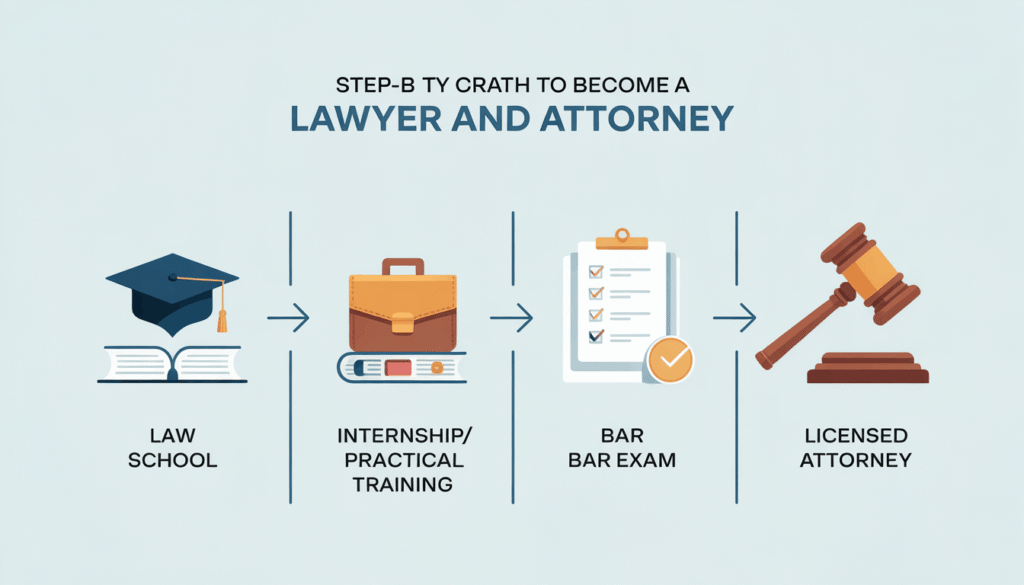
The process of becoming a lawyer or an attorney begins with the same educational path, but there is one important additional requirement for attorneys. Both professionals must complete legal education and gain practical experience in the legal field. However, an attorney must also pass the bar examination and obtain a legal license that allows them to represent clients in court.
Below are the main steps involved in becoming a lawyer or an attorney.
1. Earn a Law Degree
The first step is completing a formal legal education. Most aspiring legal professionals begin by earning a law degree such as a Juris Doctor (JD) in the United States or a Bachelor of Laws (LLB) in many other countries.
During law school, students study essential legal subjects such as:
- Constitutional law
- Criminal law
- Contract law
- Civil procedure
- Legal research and writing
This academic training builds a strong foundation for understanding legal systems, interpreting laws, and solving complex legal problems.
Typical duration: 3–4 years
2. Complete Internship or Practical Training
While studying or after graduating from law school, many students gain practical experience through internships, clerkships, or legal training programs. Working under experienced legal professionals helps them understand how legal work is handled in real-world situations.
During this stage, aspiring lawyers often learn how to:
- Conduct legal research
- Draft legal documents and contracts
- Assist in case preparation
- Communicate with clients
- Observe court proceedings
This practical training helps bridge the gap between academic knowledge and professional legal practice.
Typical duration: 6–12 months
3. Pass the Bar Examination
To become an attorney, candidates must pass the bar exam in the jurisdiction where they plan to practice law. The bar examination is a comprehensive test that evaluates a candidate’s understanding of legal principles, ethics, and court procedures.
Passing the bar exam proves that the individual has the knowledge and competence required to represent clients and practice law professionally.
Typical preparation time: 3–6 months
4. Obtain a License to Practice Law
After successfully passing the bar exam, the candidate must apply for a legal license from the relevant legal authority or bar association. Once the license is granted, the individual officially becomes an attorney and is legally authorized to practice law and represent clients in court.
Licensed attorneys can perform tasks such as:
- Representing clients in court proceedings
- Filing lawsuits and legal motions
- Negotiating settlements
- Providing full legal representation
Typical Timeline to Become a Lawyer or Attorney
The entire process usually takes several years, depending on the country and legal system.
| Stage | Estimated Time |
| Law Degree | 3–4 years |
| Internship / Practical Training | 6–12 months |
| Bar Exam Preparation | 3–6 months |
Quick Summary
In simple terms, a lawyer is someone who has completed legal education and understands the law. An attorney is a lawyer who has also passed the bar exam and obtained a legal license that allows them to represent clients in court.
Advantages and Limitations of Hiring a Lawyer vs an Attorney
Understanding the advantages and limitations of hiring a lawyer or an attorney can help individuals and businesses choose the right legal professional for their needs. While both professionals have legal training and knowledge, their roles and capabilities can differ depending on licensing requirements and their ability to represent clients in court.
Before exploring the detailed benefits of each role, the table below provides a quick comparison between lawyers and attorneys.
| Aspect | Lawyer | Attorney |
| Cost | Generally lower for consultations and document work | Usually higher due to court representation |
| Court Representation | May not always represent clients in court | Fully authorized to represent clients in court |
| Legal Advice | Can provide legal guidance and consultation | Can provide legal advice and litigation support |
| Licensing | May not always require a bar license depending on role | Must pass the bar exam and obtain a legal license |
This comparison highlights why the choice between a lawyer and an attorney often depends on the type of legal assistance required.
Advantages of Hiring a Lawyer
Hiring a lawyer can be beneficial in many legal situations, especially when you need professional legal guidance, document preparation, or strategic advice without necessarily going to court.
1. Legal Advice and Consultation
Lawyers are trained to interpret laws and regulations. They can provide valuable advice on legal matters such as business contracts, family disputes, property agreements, and compliance issues.
2. Legal Research and Documentation
Lawyers can conduct detailed legal research and prepare important documents such as contracts, agreements, wills, and legal notices. Their expertise helps ensure that documents meet legal standards and reduce the risk of future disputes.
3. Cost-Effective for Non-Litigation Matters
If your legal needs mainly involve consultation, document drafting, or reviewing agreements, hiring a lawyer can often be more affordable than hiring an attorney who focuses on courtroom representation.
4. Preventive Legal Guidance
A lawyer can help identify potential legal risks before they turn into serious problems. This preventive approach is particularly valuable for businesses, startups, and individuals who want to avoid legal conflicts in the future.
Limitation:
One key limitation is that a lawyer who has not passed the bar exam or obtained the necessary license may not be legally allowed to represent clients in court.
Advantages of Hiring an Attorney
An attorney provides all the legal knowledge of a lawyer but also has the legal authority to represent clients in court. This makes attorneys essential for handling legal disputes, lawsuits, and litigation matters.
1. Court Representation
Attorneys are licensed legal professionals who can represent clients in court. They can present arguments, question witnesses, submit evidence, and defend their clients before judges or juries.
2. Litigation Expertise
Attorneys specialize in managing legal disputes such as criminal cases, civil lawsuits, personal injury claims, and family law matters. Their experience with legal procedures and courtroom strategies can significantly influence the outcome of a case.
3. Legal Authority and Licensing
Attorneys must pass the bar examination and obtain a legal license before practicing law. This licensing ensures that they meet professional and ethical standards required to represent clients legally.
4. Full Legal Representation
An attorney can manage every stage of a legal case—from providing legal advice and drafting documents to negotiating settlements and representing clients during court trials.
Limitation:
Because attorneys handle complex legal matters and provide courtroom representation, their services often involve higher legal fees compared to general legal consultations.
Frequently Asked Questions (FAQ)
Is every attorney a lawyer?
Yes, every attorney is a lawyer, but not every lawyer is an attorney. A lawyer is someone who has studied law and earned a law degree. An attorney, on the other hand, is a lawyer who has also passed the bar exam and is legally licensed to represent clients in court. In simple terms, all attorneys are trained lawyers, but only those who are licensed to practice law in court are called attorneys.
Can a lawyer represent someone in court?
Not always. A lawyer can provide legal advice, draft documents, and assist with legal research. However, in many jurisdictions, a lawyer must pass the bar examination and obtain a legal license to represent clients in court. Once a lawyer is officially licensed to practice law, they are often referred to as an attorney.
Is an attorney higher than a lawyer?
No, an attorney is not necessarily higher than a lawyer. The difference mainly depends on licensing and legal authority. A lawyer is someone who has completed legal education, while an attorney is a lawyer who has passed the bar exam and is authorized to represent clients in court. In most cases, the terms refer to professionals at similar levels of legal expertise.
Why are lawyers called attorneys?
The term “attorney” comes from the Old French word atorné, which means a person appointed to act on behalf of another. In the legal profession, an attorney is someone who is legally authorized to represent and act for a client in legal matters, particularly in court proceedings.
Can a lawyer practice law without a license?
In most jurisdictions, a lawyer cannot officially practice law or represent clients in court without a license. After completing a law degree, the individual must pass the bar exam or meet other licensing requirements set by the legal authority in that region. Only after obtaining this license can they legally practice law as an attorney.
Which term is used in the UK?
In the United Kingdom, the term “attorney” is not commonly used in everyday legal practice. Instead, legal professionals are usually referred to as solicitors or barristers. Solicitors typically provide legal advice and prepare cases, while barristers specialize in representing clients in court.
Is an advocate the same as an attorney?
Not exactly. An advocate is a legal professional who is qualified to represent clients in court, particularly in countries such as India. While the roles of an advocate and an attorney can be similar, the terminology varies depending on the country and legal system.
Which one should you hire?
The choice depends on your legal needs. If you need general legal advice, document drafting, or consultation, a lawyer may be sufficient. However, if your case involves court representation, litigation, or legal disputes, you should hire an attorney who is licensed to represent clients in court.
Lawyer vs Attorney: Quick Summary
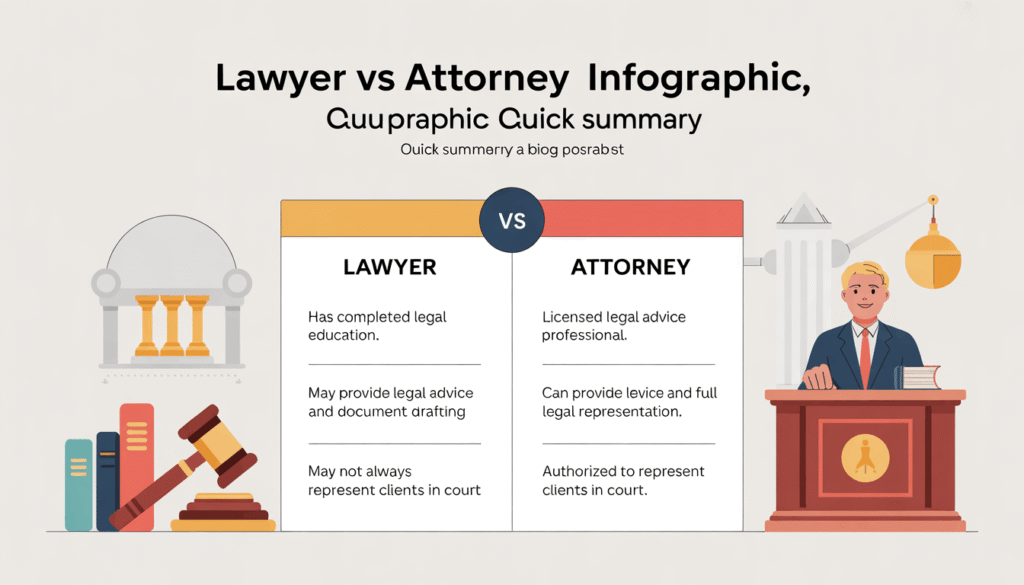
Understanding the difference between a lawyer and an attorney can be simplified by looking at their core qualifications and roles. While both professionals have legal education and knowledge of the law, the key distinction lies in licensing and the authority to represent clients in court.
| Lawyer | Attorney |
| Has completed legal education such as a law degree | Licensed legal professional who has passed the bar exam |
| May provide legal advice, research, and document drafting | Can provide legal advice and full legal representation |
| May not always represent clients in court | Authorized to represent clients in court |
| Often focuses on legal consultation and documentation | Often focuses on litigation and court proceedings |
In simple terms:
A lawyer is anyone who has studied law and understands the legal system, while an attorney is a lawyer who is officially licensed to practice law and represent clients in court. This is why the phrase “all attorneys are lawyers, but not all lawyers are attorneys” is commonly used to explain the difference.
Conclusion
Understanding the difference between a lawyer and an attorney is important when seeking legal help or exploring a career in the legal field. Although the two terms are often used interchangeably, they do not always mean exactly the same thing. A lawyer is someone who has studied law and earned a law degree, allowing them to provide legal advice, conduct research, and assist with legal documentation. An attorney, on the other hand, is a lawyer who has passed the bar exam and is legally authorized to represent clients in court.
In simple terms, all attorneys are lawyers, but not all lawyers are attorneys. The main distinction lies in licensing and the ability to practice law in court. Attorneys have the legal authority to act on behalf of clients in legal proceedings, while lawyers may focus on advisory or supportive legal roles depending on their qualifications and licensing.
By understanding this difference, individuals and businesses can make better decisions about the type of legal professional they need—whether it’s a lawyer for legal guidance or an attorney for court representation and litigation.