

Is Jaywalking Legal in California? (2026 Law Update)
Yes — jaywalking is partially legal in California under the state’s updated pedestrian law known as the Freedom to Walk Act (AB 2147). As of 2026, pedestrians in California can legally cross outside a marked crosswalk in many situations if doing so does not create an immediate danger of collision with a vehicle. However, dangerous or reckless jaywalking is still illegal, and police may still issue citations for unsafe crossings.
Quick Answer
| Question | Answer |
| Is jaywalking legal in California? | Partially yes |
| What changed? | AB 2147 reduced jaywalking enforcement |
| Can pedestrians cross outside a crosswalk? | Often yes, if safe |
| Can you still get a ticket? | Yes |
| Is dangerous jaywalking illegal? | Yes |
| Main law involved | California Vehicle Code §21955 |
| Law effective date | January 1, 2023 |
Key Takeaways
- California changed its jaywalking laws through the Freedom to Walk Act (AB 2147).
- Safe crossing outside a crosswalk is no longer automatically illegal.
- Police generally cannot stop pedestrians unless the crossing creates an immediate danger.
- Unsafe jaywalking can still result in citations.
- Drivers and pedestrians both share legal safety responsibilities.
- Jaywalking can still affect pedestrian accident claims under California comparative negligence rules.
What Changed Under AB 2147?
California’s updated jaywalking law shifted enforcement away from technical violations and toward actual safety risks.
Before the law changed, pedestrians could receive tickets simply for crossing outside a marked crosswalk — even when no traffic was nearby. Under the Freedom to Walk Act, police officers generally may only stop or cite pedestrians when a crossing creates an immediate danger of collision.
For many Californians, the law change reflects how people already walk in everyday life, especially in quiet neighborhoods or low-traffic areas where crossing mid-block may be common and reasonably safe.
That does not mean pedestrians can cross however they want. Dangerous roadway behavior is still illegal throughout California.
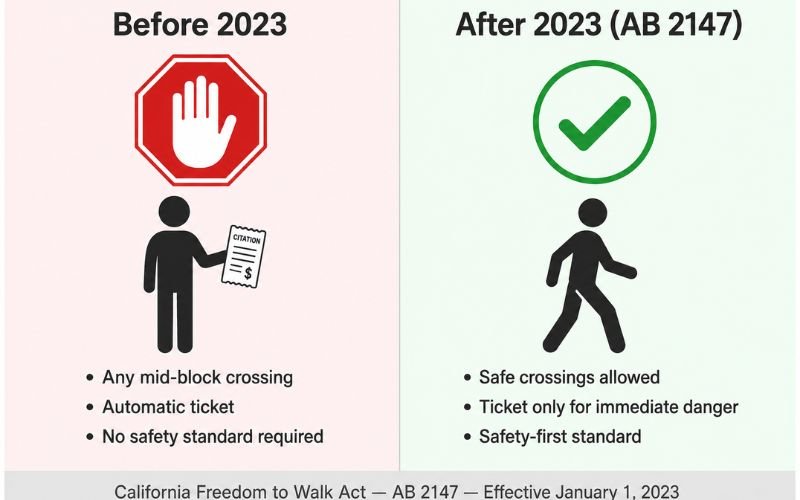
Is Jaywalking Legal in California?
In many situations, yes.
Under current California law, pedestrians may legally cross streets outside marked crosswalks when traffic conditions make the crossing reasonably safe.
The key issue is no longer simply whether someone crossed mid-block. Instead, the law focuses on whether the pedestrian created an immediate hazard to traffic.
That distinction is important.
A person crossing a quiet residential street in Santa Monica at midday faces a very different legal situation than someone running across six lanes of traffic in downtown Los Angeles during rush hour.
California’s updated jaywalking law recognizes that difference.
Simple Definition of Jaywalking
Jaywalking generally refers to:
- Crossing outside a marked or unmarked crosswalk
- Crossing against pedestrian traffic signals
- Walking into traffic outside designated crossing areas
Historically, California treated many of these actions as automatic violations. Today, enforcement depends much more on roadway safety and traffic conditions.
What Is California’s Freedom to Walk Act (AB 2147)?
The Freedom to Walk Act is the California law that changed statewide jaywalking enforcement rules.
The legislation, formally known as AB 2147, was signed into law in 2022 and took effect on January 1, 2023.
Its purpose was not to completely legalize jaywalking. Instead, the law reduced penalties for safe pedestrian crossings while still allowing enforcement against dangerous behavior.
Why the Law Was Changed
Supporters of AB 2147 argued that previous jaywalking enforcement often:
- Criminalized low-risk pedestrian behavior
- Resulted in unnecessary police stops
- Disproportionately impacted minority communities
- Did little to improve roadway safety
In practice, many pedestrians already crossed streets outside crosswalks in low-traffic situations without creating meaningful danger.
The updated law attempted to reflect that reality while maintaining public safety standards.
When Did California Jaywalking Laws Change?
California’s jaywalking laws officially changed on:
January 1, 2023
Since then, the Freedom to Walk Act has applied statewide, including in:
- Los Angeles
- San Francisco
- San Diego
- Sacramento
- Oakland
- Long Beach
- Anaheim
- Santa Monica
As of 2026, the law remains active throughout California.
When Is Jaywalking Legal in California?
Jaywalking is generally legal when pedestrians cross safely and do not interfere with nearby traffic.
The most important factor is whether the crossing creates an immediate danger of collision.
Examples of Potentially Legal Jaywalking
Crossing an Empty Residential Street
Imagine someone crossing a quiet neighborhood road where no vehicles are nearby.
Under current California law, that type of crossing is often legal.
Crossing Mid-Block With Clear Visibility
A pedestrian crossing a calm downtown street with no approaching traffic may also be acting lawfully.
Drivers are not forced to brake suddenly, swerve, or react dangerously.
Crossing at Night When Conditions Are Safe
Nighttime jaywalking is not automatically illegal.
However, visibility becomes extremely important. If drivers can clearly see the pedestrian and traffic conditions are safe, the crossing may still be lawful.
The “Immediate Danger” Standard Explained
California’s updated pedestrian law focuses heavily on whether the pedestrian creates:
An immediate danger of collision.
Police officers may consider:
- Traffic speed
- Distance between vehicles
- Road lighting
- Weather conditions
- Driver reaction time
- Traffic density
- Visibility
This standard gives officers more discretion than the previous law.
When Is Jaywalking Still Illegal?
Unsafe jaywalking remains illegal throughout California.
The Freedom to Walk Act did not eliminate pedestrian safety laws.
Examples of Illegal Jaywalking
Crossing Directly Into Heavy Traffic
A pedestrian stepping into fast-moving traffic where drivers must brake suddenly can still receive a citation.
Running Across Busy Intersections
Crossing recklessly through active intersections remains unlawful in many situations.
Crossing Highways or Freeways
Pedestrians generally cannot legally cross freeway lanes or high-speed highway traffic.
Creating Unsafe Driver Reactions
If drivers must:
- Slam on brakes
- Swerve unexpectedly
- Stop abruptly
the crossing may still violate California law.
Can You Get a Jaywalking Ticket in California?
Yes.California still allows jaywalking citations when pedestrians create unsafe traffic conditions.
That is one of the biggest misconceptions surrounding AB 2147.
Many people incorrectly assume jaywalking became fully legal statewide. It did not.
Situations That May Lead to a Ticket
Police may still issue citations for:
- Reckless roadway crossings
- Walking into active traffic
- Ignoring dangerous traffic conditions
- Creating immediate collision risks
- Unsafe nighttime crossings
In practice, officers now focus more on roadway safety than technical crossing violations.
How Much Is a Jaywalking Fine in California?
A jaywalking ticket in California may still cost between:
Approximately $150 to $250+
The original base fine may appear low, but additional court fees and assessments can significantly increase total costs.
| Violation | Estimated Cost |
| Base fine | Around $25 |
| Fees and assessments | Often much higher |
| Typical total cost | $150–$250+ |
Actual fines vary depending on the county and court system involved.
Can Police Still Stop You for Jaywalking?
Yes, although police authority is more limited than before.
Under AB 2147, officers generally should not stop pedestrians solely because they crossed outside a crosswalk when no immediate danger existed.
However, police may still intervene if they reasonably believe the pedestrian created a traffic hazard.
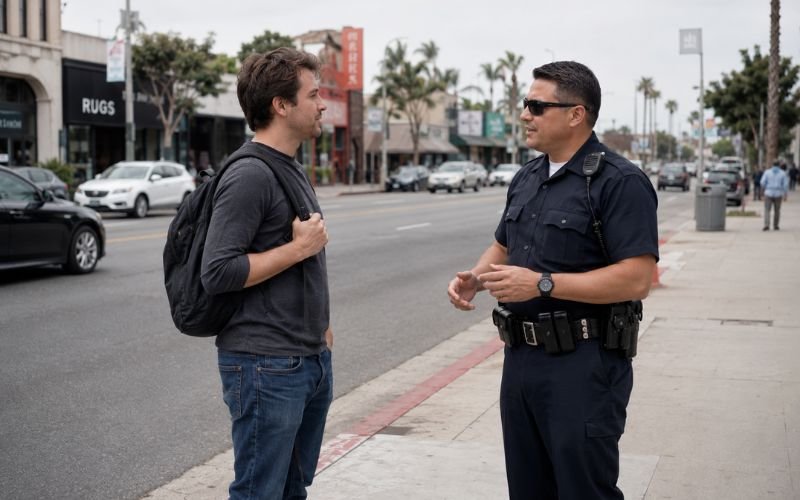
Real-World Example
Likely Legal Situation
Someone crosses an empty side street in a residential neighborhood with no nearby traffic.
Likely Illegal Situation
Someone suddenly runs across a six-lane boulevard during heavy rush-hour traffic, forcing drivers to brake aggressively.
The key issue becomes roadway safety — not merely whether a crosswalk was used.
California Vehicle Code §21955 Explained
California Vehicle Code §21955 is one of the state’s primary pedestrian crossing laws.
Historically, this law required pedestrians to use marked crosswalks between adjacent intersections controlled by traffic signals.
How AB 2147 Changed Enforcement
Under current California law, crossing outside a crosswalk is not automatically punishable.
Instead, police generally focus on whether the crossing creates an immediate safety risk.
Why Vehicle Code §21955 Still Matters
Even after AB 2147:
- Pedestrians must still act reasonably
- Dangerous crossings remain illegal
- Traffic safety laws still apply
- Courts may still examine pedestrian behavior after accidents
The law changed enforcement standards — not the importance of roadway safety.
Is Jaywalking Legal in Los Angeles?
Yes, in many situations.
Los Angeles follows the same statewide pedestrian rules created under the Freedom to Walk Act.
However, Los Angeles presents unique traffic risks because of:
- Wide intersections
- Heavy traffic congestion
- High-speed boulevards
- Dense pedestrian activity
Realistic Example
Crossing a calm residential street in Echo Park is very different from attempting to cross Sunset Boulevard during peak traffic hours.
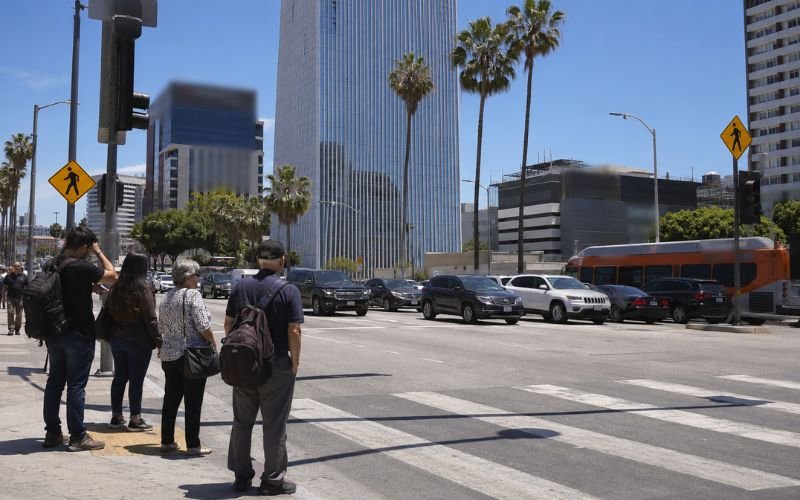
Even with relaxed enforcement, unsafe crossings in Los Angeles may still result in citations.
Is Jaywalking Legal in San Francisco?
Generally yes, when done safely.
San Francisco’s dense pedestrian traffic and walkable neighborhoods make jaywalking enforcement particularly relevant.
However, visibility challenges can increase risks in the city.
Important Safety Considerations
Pedestrians should remain cautious around:
- Steep hills
- Cable car routes
- Tourist-heavy intersections
- Foggy conditions
- Nighttime visibility limitations
-

San Francisco’s steep hills, frequent fog, and cable car routes create visibility challenges that directly affect whether a pedestrian crossing is considered legally safe.
A crossing that appears safe to a pedestrian may still create visibility issues for drivers approaching downhill streets.
Is Jaywalking Legal in San Diego?
Yes, safe jaywalking may be legal in San Diego under California’s current pedestrian laws.
Like the rest of California, San Diego follows statewide enforcement standards under AB 2147.
Areas Where Extra Caution Is Important
- Beachfront roads
- Tourist districts
- Downtown nightlife areas
- Multi-lane coastal roads
Drivers in heavily visited areas may be distracted or unfamiliar with traffic patterns, increasing pedestrian risks.
Can Tourists Jaywalk in California?
Yes, but the same laws apply to everyone.
Tourists visiting California are subject to the same pedestrian rules as California residents.
Common Tourist Misunderstandings
Some visitors assume:
- Jaywalking is now fully legal
- Police cannot issue citations anymore
- Crosswalk rules no longer matter
Those assumptions are incorrect.
California’s updated law protects safe pedestrian behavior — not dangerous roadway conduct.
What Happens If a Jaywalking Pedestrian Gets Hit by a Car?
A pedestrian who was jaywalking can still potentially recover compensation after an accident in California.
That surprises many people.
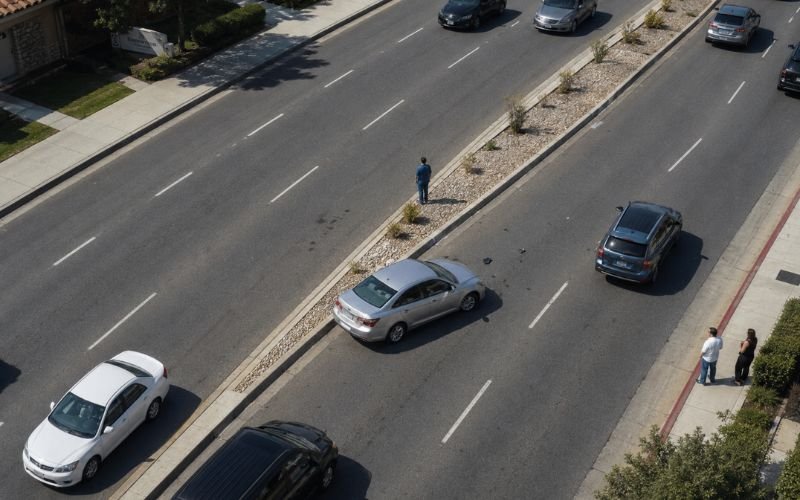
Under California law, fault is not always assigned entirely to one party.
Instead, courts often examine:
- Driver speed
- Visibility
- Traffic conditions
- Pedestrian actions
- Driver distraction
- Roadway design
Example Scenario
A pedestrian crosses mid-block legally while a distracted driver looks at a phone and fails to stop in time.
Even though the pedestrian crossed outside a crosswalk, the driver may still bear substantial responsibility.
Another Example
A pedestrian suddenly runs across a poorly lit roadway at night where approaching drivers have almost no reaction time.
In that situation, the pedestrian may share significant fault.
Situations Where Legal Guidance May Be Helpful
Pedestrians or drivers may seek legal guidance after accidents involving:
- Serious injuries
- Hit-and-run crashes
- Insurance disputes
- Crosswalk disagreements
- Distracted driving allegations
- Nighttime pedestrian collisions
- Shared-fault accident claims
Because fault in pedestrian accident cases can become complicated under California comparative negligence rules, injured individuals often seek legal guidance to better understand liability and insurance issues after a crash.
How Comparative Negligence Works in California
California uses a legal system called:
Pure Comparative Negligence
This means an injured person may still recover compensation even if they were partially responsible for the accident.
Example
| Party | Fault |
| Distracted driver | 70% |
| Pedestrian crossing unsafely | 30% |
If total damages equal $100,000:
- The pedestrian may still recover $70,000.
Why This Matters
Jaywalking does not automatically prevent injury claims.
Courts usually examine the full situation, including:
- Whether the driver was speeding
- Whether the pedestrian was visible
- Road lighting conditions
- Traffic flow
- Signal timing
- Driver attention
California courts focus on shared responsibility rather than automatic blame.
California Pedestrian Accident Statistics
California consistently reports some of the nation’s highest pedestrian accident numbers.
Several factors contribute to this, including:
- Dense urban traffic
- Tourism
- Distracted driving
- Large pedestrian populations
- High-speed roads
- Nighttime visibility issues
Common Causes of Pedestrian Accidents
- Speeding
- Failure to yield
- Distracted driving
- Unsafe crossings
- Alcohol impairment
- Poor roadway visibility
- Aggressive driving
Pedestrian accidents occur most frequently near:
- Busy intersections
- Downtown entertainment districts
- Tourist areas
- Schools
- Commercial corridors
California Jaywalking Law Before vs After AB 2147
| Issue | Before AB 2147 | After AB 2147 |
| Crossing outside a crosswalk | Usually illegal | Often legal if safe |
| Police enforcement | Broad authority | More limited |
| Focus of enforcement | Technical violation | Immediate danger |
| Ticket likelihood | Much higher | Lower |
| Safe residential crossings | Frequently ticketed | Often allowed |
| Dangerous crossings | Illegal | Still illegal |
| Pedestrian flexibility | Limited | Expanded |
Biggest Legal Change
The law shifted enforcement away from:
“Did the pedestrian technically cross outside a crosswalk?”
and toward:
“Did the pedestrian create a dangerous traffic situation?”
That distinction changed how California handles pedestrian enforcement statewide.
Common Myths About Jaywalking in California
Myth 1: Jaywalking Is Completely Legal
False.
Dangerous or reckless roadway crossings remain illegal.
Myth 2: Police Cannot Stop Pedestrians Anymore
False.
Police may still stop pedestrians who create immediate traffic hazards.
Myth 3: Crosswalks No Longer Matter
False.
Crosswalks remain the safest and legally preferred places to cross.
Myth 4: Drivers Are Always Responsible in Pedestrian Crashes
False.
Pedestrians also have legal duties to act reasonably and safely.
Myth 5: Tourists Are Exempt From California Jaywalking Laws
False.
Visitors must follow the same pedestrian laws as California residents.
Pedestrian Safety Tips in California
Even with reduced jaywalking enforcement, safety should remain the top priority for pedestrians and drivers alike.
Pedestrian Safety Tips
- Use crosswalks whenever practical
- Avoid sudden roadway crossings
- Stay visible at night
- Avoid distractions while walking
- Watch for turning vehicles
- Never assume drivers will stop
- Cross in well-lit areas whenever possible
Nighttime Crossing Tips
Nighttime visibility dramatically affects pedestrian safety.
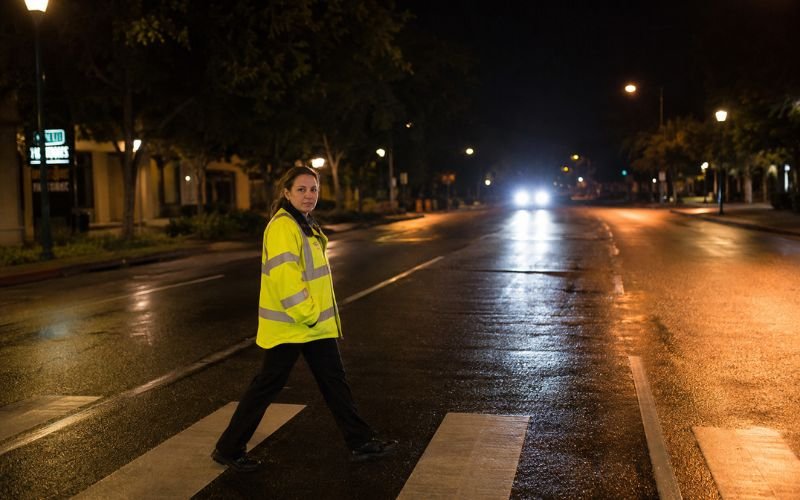
Pedestrians should:
- Wear reflective clothing when possible
- Avoid dark high-speed roads
- Remain alert near intersections
- Be cautious around parked cars that block visibility
Driver Responsibilities
Drivers in California must also exercise reasonable care.
That includes:
- Yielding appropriately
- Watching for pedestrians
- Avoiding distracted driving
- Slowing near crosswalks
- Remaining cautious in dense urban areas
Pedestrian safety is a shared responsibility under California law.
Why Trust This Guide?
This article was prepared using publicly available California pedestrian statutes, statewide enforcement guidance, and current information related to California Vehicle Code §21955 and the Freedom to Walk Act (AB 2147).
The goal of this guide is to provide neutral, easy-to-understand legal information for California residents, drivers, pedestrians, and tourists seeking accurate information about California jaywalking laws in 2026.
This article is informational only and does not constitute legal advice.
Frequently Asked Questions
Is jaywalking completely legal in California?
No.California legalized many safe crossings outside crosswalks, but dangerous jaywalking remains illegal.
Can you still get a jaywalking ticket?
Yes.Police may still issue citations when a pedestrian creates an immediate traffic danger.
Is jaywalking legal if no cars are coming?
Often yes.If traffic conditions are reasonably safe and no immediate danger exists, crossing outside a crosswalk may be lawful.
Is jaywalking legal at night?
Sometimes.Nighttime crossings are evaluated based on visibility, traffic conditions, and roadway safety.
What is AB 2147?
AB 2147 is California’s Freedom to Walk Act, which reduced enforcement for safe jaywalking situations.
Can tourists jaywalk in California?
Tourists must follow the same California pedestrian laws as residents.
Can pedestrians cross anywhere?
Not necessarily.Pedestrians should still avoid dangerous traffic situations and unsafe crossings.
Is crossing outside a crosswalk illegal?
Not automatically anymore.Under California’s updated law, crossing outside a crosswalk may be legal when done safely.
Can jaywalking affect accident claims?
Yes.A pedestrian’s conduct may reduce compensation under California comparative negligence rules.
Is jaywalking a misdemeanor?
Usually no.Most jaywalking violations are infractions rather than criminal misdemeanors.
Conclusion
So, is jaywalking legal in California in 2026?
In many situations, yes.
California’s Freedom to Walk Act significantly changed how jaywalking laws are enforced by allowing pedestrians to cross outside marked crosswalks when traffic conditions are reasonably safe and do not create an immediate danger.
At the same time, unsafe jaywalking remains illegal.
Pedestrians should still use caution near busy intersections, highways, nighttime traffic, and high-speed roadways. Drivers also remain legally responsible for exercising reasonable care around pedestrians.
If a pedestrian accident occurs, understanding how California’s updated jaywalking laws affect fault, liability, and insurance claims can become extremely important for both pedestrians and drivers.
Because pedestrian accident cases often depend on visibility, traffic conditions, driver behavior, and roadway design, people involved in serious pedestrian crashes may benefit from speaking with a qualified California traffic or personal injury attorney to better understand their legal options.
The safest approach remains simple:
- Use crosswalks whenever possible
- Stay visible
- Avoid sudden crossings
- Never assume traffic will stop
California may now allow more pedestrian flexibility, but roadway safety is still the law’s top priority.