

Virtual Legal Assistant Services: The Ultimate Guide to Modern Law Firm
Introduction: What a Virtual Legal Assistant Is?
A Virtual Legal Assistant (VLA) is an administrator-attorney who delivers remote law administrative and legal services to law firms, solo lawyers, and professionals in the legal field. Unlike conventional in-house employees, a VLA is able to work remotely and effectively complete the most important tasks, including documenting, legal research, billing, client contact, and handling cases with the help of modern legal software and cloud-based solutions.
With the legal industry undergoing digital transformation and remote operation, virtual legal assistant services are proving to be a necessary tool to the firms aiming to be efficient, scale-able, and effective in terms of costs.

The Reason Virtual Legal Assistants Are Changing Law Firms
Administrative and repetitive tasks that are not billable often cost law firms 10–20 billable hours a week. Virtual legal assistants will enable the recovery of that time as they will handle operational tasks and enable lawyers to devote their time towards strategy, litigation, and client representation.
Key Benefits Include:
- Minimization of administrative work
- Conserving time spent in legal research and preparing documents
- Maintaining contacts and follow-ups with the clients
- Flexible support according to the volume of cases
- Growing billable time and firm revenue
The trend is towards increased demand of legal outsourcing and long distance legal support in the last few years. According to industry trends, the legal outsourcing market has a forecasted growth of 20–25 percent every year in 2023 to 2025, which means VLAs have become a strategic resource to law firms of any size.
Who Doesn’t Need a Virtual Legal Assistant?
Large firms are not the only ones that are using virtual legal assistants. They add value to various segments of the legal industry.
1. Individual Attorneys and Small Firms
Lawyers working alone may have to do a combination of casework, client meetings, billing, and administration. A VLA allows them to:
- Outsource non-technical clerical jobs
- Put emphasis on client relationships and billable hours
- Access expert legal assistance without having permanent employees
- Grow operations with no additional overhead/office space
In the case of individual practitioners, the VLA may be what separates stagnation and long-term growth.
2. Middle-Sized Law Firms in Search of Scaling
Expanding companies are often faced with workload peaks and workflow inefficiencies. The virtual legal assistants assist in:
- Dealing with overload activities at peak hours
- The provision of more than one attorney at the same time
- Optimizing workflow and document turnaround time
- Expanding without long-term hiring contracts
This flexibility keeps the firms on their feet.
3. Legal Professionals, Freelance
Freelance paralegals, legal consultants, and other people working as contract attorneys tend to have more than one project in a time frame. A VLA can:
- Scheduling of coordinates and communication with the clients
- Carry out legal research and write papers offsite
- Manage time and productivity better
- Offer support on a project basis and not on long-run contract basis
Activities and Duties of a Virtual Legal Assistant
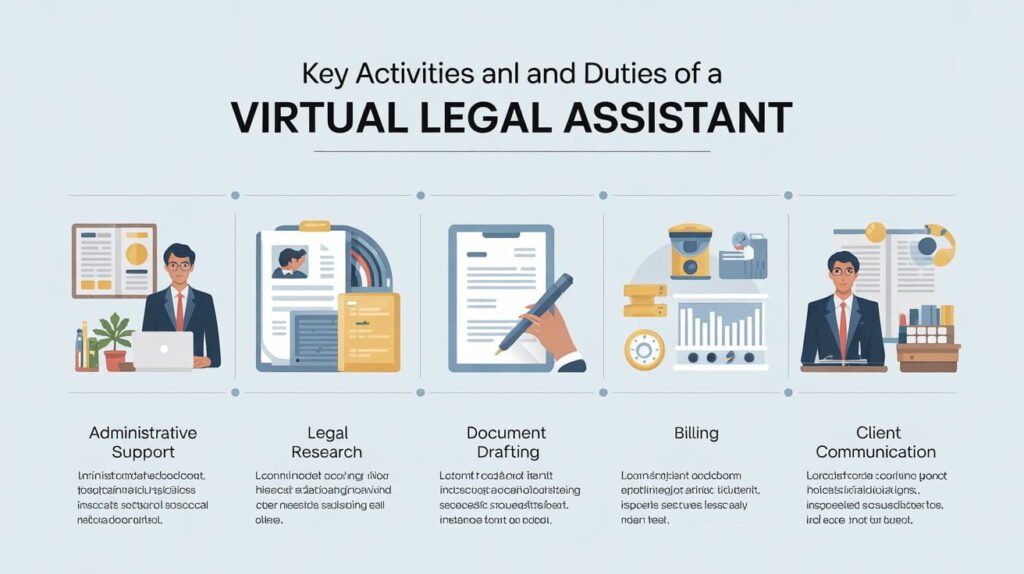
The virtual legal assistants have a wide range of duties that facilitate the running of a law firm.
1. Administrative Support
- Organization of email inbox and email management
- Appointment scheduling and calendar scheduling
- Reminders and follow-ups to the client
- Meeting organization and consultation setup
2. Document Management
- Writing contracts, agreements and correspondence
- Checking and correcting legal papers
- Cases and electronic filing
- Versioning and tracking
3. Case Preparedness and Legal Research
- Case law, statutes and regulations research
- Writing summaries and research memos
- Helping in briefing and legal paperwork
- Elaborating on prosecuting lawyers with tabulated findings
4. Billing and Financial Management
- Recording billable hours
- Preparation and dispatching invoices
- Monitoring costs and payments
- Keeping financial records
5. Client Communication
- Answering generic questions
- Scheduling consultations
- Sending case notifications and reminders
- Ensuring regular communication
6. Specialized Legal Support
- Preparation of immigration documentation
- Contract review assistance
- Filing support on intellectual property
- Research in compliance and regulations
Through such undertakings, VLAs play a significant role in alleviating the burden of operations on attorneys.
Virtual Legal Assistant vs. Other Support
The selection of the appropriate support model is based on the price, flexibility and experience.
Virtual Legal Assistant vs. In-House Assistant
| Feature | In-House Assistant | Virtual Legal Assistant |
| Cost | Wages, perks, office space | Pay only for hours/tasks |
| Flexibility | Limited to office hours | Remote and scalable |
| Expertise | May require training | Often legally specialized |
| Scalability | Requires hiring more staff | Easily adjustable |
Virtual legal assistants are more flexible and lightweight.
AI Legal Tools vs. Human Virtual Assistant
Artificial intelligence tools are good at automation and organized research, but they do not have human judgment. A VLA provides:
- Knowledge-based decision support
- Handling of client communication
- Custom drafting and review
- Flexibility to company operations
AI can be used to facilitate automation whereas VLAs offer personalized and human-based knowledge.
Virtual Legal Assistant Service Pricing and Cost Model
Knowledge in pricing assists companies to prepare budgets. There are costs that depend on experience, specialization and place.
Common Pricing Models
Hourly Rates:
Typically $25–$60 per hour in the US. Best in short-term or flexible projects.
Monthly Retainers:
Between 40–80 hours between $1,000 and $2,500 monthly. Suitable in situations that involve regular workloads.
Subscription Plans:
Depending on services and the size of the firm, it varies between $500–$3,000 per month.
Factors Affecting Cost
- Particularity of the work (research vs administration)
- Experience and specialization
- Geographic location
- Required availability
ROI for Law Firms
Hiring a VLA often leads to:
- 10–20+ hours saved weekly
- Increased billable time
- Reduced overhead costs
- Improved client satisfaction
The investment is usually overshadowed by the financial payoff.
Virtual Legal Assistant: How to Hire
The process of hiring the right VLA needs to be organized.
Where to Find VLAs
- Freelance websites (Upwork, Fiverr, Indeed)
- Specialized agencies
- Professional referrals
Ascertain experience with US legal systems and confidentiality practices always.
Key Interview Questions
- What is your legal software skills?
- What would you do to guarantee confidentiality?
- Are you able to handle various cases effectively?
- How much experience have you had in document drafting?
Onboarding Best Practices
- Give specifications of tasks
- Allow access to case management tools
- Establish performance goals
- Establish regular check-ins
KPIs to Track
- Document turnaround time
- Accuracy of research
- Client response times
- Task completion rates
Applications and Technology Virtual Legal Assistants Use
VLAs are based on modern law and productivity tools to ensure efficiency:
- Case management platforms
- Software to automate documents
- Legal research databases
- Tools of communication and task management
- Safe cloud storage systems
With such tools, there is easy cooperation and safety of data.
Practical Implementation: Effective Outcomes
Law firms which incorporate virtual legal assistants report:
- 50–60 percent decrease in administrative time
- 40% increase in billable hours
- Operational costs reduced by a quarter
- Quickened document turnaround time
- Better client response rates
These indicators prove the practical usefulness of virtual legal assistant services.
Frequently Asked Questions
Can virtual assistants conduct legal research?
Yes. VLAs can research case law, statutes, and regulations, but they do not provide legal advice. Attorneys remain responsible for final review.
Are they qualified to draft legal documents?
They can draft and format documents under attorney supervision. Final approval must come from a licensed attorney.
Is client data secure?
Reputable VLAs use encrypted systems, secure cloud storage, and confidentiality agreements to protect sensitive information.
Do virtual legal assistants work internationally?
Yes, many work remotely worldwide. Firms should consider time zones and compliance regulations when assigning tasks.
Conclusion: A Smart Investment for Modern Law Practices
Virtual Legal Assistant services provide law firms and solo attorneys with a powerful solution to increase efficiency, reduce costs, and improve client satisfaction. By outsourcing administrative and legal support tasks, attorneys gain more time for strategic, billable work.
The benefits include:
- Increased productivity
- Reduced operational burden
- Flexible and scalable support
- Access to specialized expertise
- Lower overhead compared to in-house hiring
As the legal industry continues to evolve, virtual legal assistants are no longer optional — they are a strategic advantage.
If your firm is ready to streamline operations, improve profitability, and enhance client service, hiring a virtual legal assistant could be the smartest next step.
Frequently Asked Questions
Is it possible to have virtual assistants perform a legal research?
Yes. VLAs are able to study case law, statutes, and regulations, but also do not give legal advice. Lawyers are still in charge of final inspection.
Do they qualify to write legal documents?
They are able to write and compose documents under the oversight of the attorneys. An attorney must be licensed to approve final approval.
Is client data secure?
Reliable VLAs apply encrypted system, secured cloud storage, and confidentiality contracts to secure sensitive data.
Are virtual legal assistants used on an international scale?
Yes, a lot of them are working remotely globally. Companies need to take into account time and regulations when delegating duties.
Summary: A Shrewd Investment in the Contemporary Religious Law.
Virtual Legal Assistant services will offer law firms and individual attorneys with a clear-cut solution to enhance their efficiency, save money, and enhance client satisfaction. Outsourcing administrative and legal support services will enable the attorneys to have additional time to doing strategic and billable work.
The benefits include:
Increased productivity
- Reduced operational burden
- Scalable and elastic support.
- Availability of professional knowledge.
- Reduced overhead as compared to internal recruitment.
With the development of the legal industry, the virtual legal assistants are not merely optional anymore, but a competitive edge.
Should your company be willing to simplify the work process, increase its profitability, and provide better customer service, it would be the most intelligent move to hire a virtual legal assistant.