Labor-Employment Law 2026: New Wage Rules & Employee Rights in USA [Expert Guide]
Introduction
In 2026, navigating the latest updates in Labor-Employment Law 2026 in the USA is critical for businesses aiming to avoid costly penalties, federal investigations, and employee lawsuits. With evolving federal and state regulations, employers across the United States must stay compliant with updated wage laws, overtime rules, and workplace protection standards.
In today’s rapidly changing business environment, labor-employment law shapes every stage of the employer–employee relationship — from hiring and onboarding to compensation, workplace safety, anti-discrimination compliance, and lawful termination procedures. Whether you are a U.S. employer managing workforce compliance or an employee seeking clarity about your workplace rights, understanding current labor-employment regulations is essential.
As federal agencies strengthen enforcement of wage and hour laws, workplace safety standards, and equal employment regulations, organizations must take a proactive compliance approach. A clear understanding of labor-employment compliance requirements in the USA not only reduces legal disputes but also protects businesses from financial liability and reputational damage.
In this expert guide, we will break down the latest federal wage updates, employee rights protections, and compliance strategies under Labor-Employment Law 2026 to help U.S. employers and workers stay legally secure.
What Is Labor-Employment Law?
Labor-employment law is a comprehensive legal framework that regulates the relationship between employers and employees throughout the entire employment lifecycle. It establishes the rules, rights, and responsibilities that govern how businesses hire, manage, compensate, and, when necessary, terminate workers.
At its core, labor-employment regulations are designed to maintain fairness, protect workplace rights, and ensure legal compliance in both small businesses and large organizations. These laws create structured standards that promote transparency, accountability, and equal treatment within the workplace.
Key Areas Covered Under Labor-Employment Law in the USA
Labor-Employment Law 2026 in the USA includes a wide range of federal and state regulations that govern employer–employee relationships. Below are the core areas covered under U.S. labor-employment legislation, along with relevant legal context and regulatory references:
- Employee Rights and Protections – Safeguards against workplace discrimination, harassment, and wrongful termination (enforced under federal civil rights laws and overseen by the U.S. Equal Employment Opportunity Commission).
- Workplace Safety Standards – Requirements to maintain safe and healthy working environments under the Occupational Safety and Health Act (regulated by the Occupational Safety and Health Administration).
- Minimum Wage and Wage Payment Laws – Establishing federal minimum wage standards and ensuring timely compensation under the Fair Labor Standards Act (with periodic updates influenced by inflation and state-level adjustments).
- Overtime Pay Regulations – Defining non-exempt employee eligibility and overtime compensation rules under FLSA guidelines (including salary threshold updates and Department of Labor revisions in 2026).
- Anti-Discrimination and Equal Opportunity Policies – Protecting workers from bias based on race, gender, religion, age, disability, or national origin under Title VII and related federal employment laws.
- Hiring, Contracts, and Termination Procedures – Regulating lawful dismissal practices, at-will employment limitations, final wage payments, and documentation standards under federal and state labor codes.
- Workplace Compliance Requirements – Mandating accurate payroll records, I-9 verification compliance, employee classification standards (W-2 vs. independent contractor), and adherence to U.S. Department of Labor reporting requirements.
Why Labor-Employment Law Matters
The primary objective of labor-employment law is to create balanced working conditions that protect employees while also providing legal clarity for employers. For employees, these laws ensure fair wages, safe environments, and protection of fundamental rights. For employers, proper labor-employment compliance reduces the risk of lawsuits, financial penalties, and reputational damage.
In an era of evolving workplace regulations and stricter enforcement policies, understanding labor-employment law is critical for maintaining long-term business stability and workforce trust.
Key Areas of Labor-Employment Regulations
Understanding the core components of labor-employment regulations is essential for maintaining workplace compliance and avoiding costly legal disputes. One of the most critical areas under labor-employment law is wage and hour compliance, which directly impacts payroll management, employee satisfaction, and legal risk exposure.
1. Wage and Hour Laws (USA 2026 Update)
Under Labor-Employment Law 2026 in the USA, wage and hour regulations remain one of the most strictly enforced compliance areas. These laws determine employee compensation standards, overtime calculations, and lawful working hour structures under both federal and state regulations.
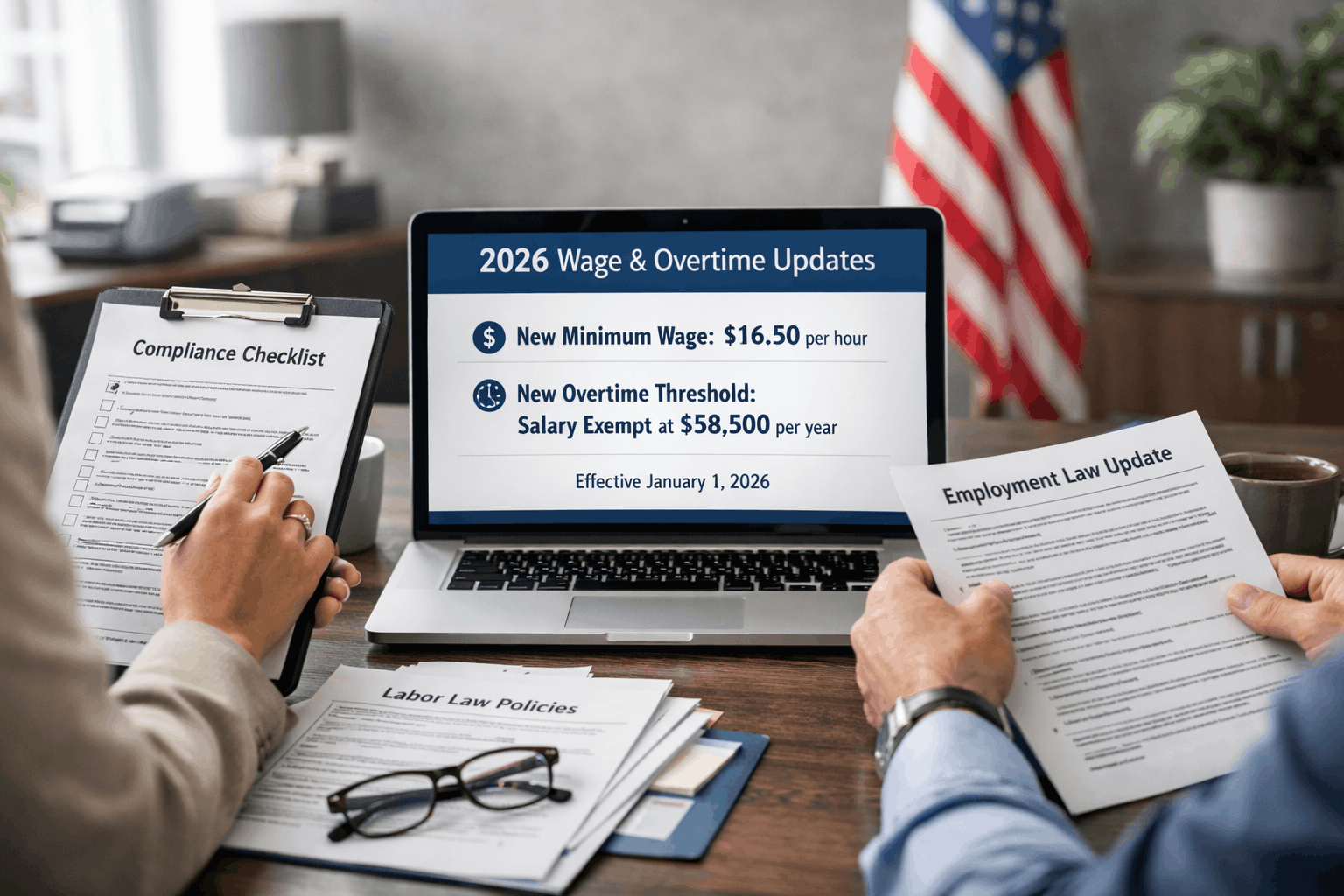
At the federal level, wage and overtime requirements are governed by the Fair Labor Standards Act (FLSA), enforced by the U.S. Department of Labor. The federal minimum wage remains $7.25 per hour. However, employers must understand that federal law sets only the baseline standard.
In 2026, many states have established significantly higher minimum wages. For example:
- California requires minimum wages exceeding $16 per hour (higher in some cities).
- New York has regional wage rates that exceed $16–$17 per hour in certain areas.
- Washington maintains one of the highest statewide minimum wages, above $16 per hour.
When federal and state laws differ, employers must comply with the higher applicable rate to remain legally compliant.
In addition to minimum wage rules, wage and hour compliance in 2026 also includes:
- Proper employee classification (exempt vs. non-exempt)
- Accurate overtime calculation (typically 1.5× regular pay after 40 hours per week under FLSA)
- Timely wage payments
- Record-keeping requirements
Failure to follow state-specific wage laws can trigger audits, back-pay liabilities, and financial penalties.
Key Areas Covered Under Wage and Hour Laws
- Minimum Wage Requirements – Employers must comply with the federal minimum wage, while also monitoring higher state-level minimum wage mandates where applicable.
- Overtime Pay Eligibility – Non-exempt employees are generally entitled to overtime pay for hours worked beyond 40 hours per week.
- Working Hour Regulations – Certain sectors have industry-specific hour limitations to ensure employee safety and compliance.
- Payroll & Record-Keeping Standards – Employers must maintain detailed timekeeping and payroll documentation to meet federal audit requirements.
Major Wage & Overtime Updates: 2025 vs 2026
Below is a simplified comparison highlighting key regulatory focus areas under U.S. labor-employment compliance:
| Regulation | 2025 Standard | 2026 Update / Enforcement Focus |
| Federal Minimum Wage | $7.25 per hour (federal baseline) | Continued federal baseline, but increased state-level minimum wage enforcement |
| Overtime Rate | 1.5× regular pay after 40 hours/week | Expanded salary threshold reviews for exempt vs. non-exempt classification |
| Salary Threshold (Exempt Employees) | Prior DOL threshold standard | Proposed / updated Department of Labor review for exemption eligibility |
| Remote Work Time Tracking | Basic tracking policies | Stricter documentation of remote employee work hours |
| Payroll Record Retention | Standard federal record-keeping rules | Increased digital audit enforcement & classification scrutiny |
Why This Matters in 2026
Wage and hour violations are among the most common labor-employment lawsuits in the United States. Misclassification of employees, unpaid overtime claims, and improper payroll documentation can result in back pay liabilities, federal penalties, and class-action litigation.
For U.S. employers, conducting periodic payroll audits and reviewing employee classification under FLSA standards is critical to maintaining labor-employment compliance in 2026.
2 Employee Rights and Workplace Protection
A core pillar of labor-employment law is the protection of employee rights and the creation of a safe, fair, and inclusive workplace. Modern labor-employment compliance frameworks are designed to ensure that employees are treated with dignity, compensated fairly, and protected from unlawful workplace practices.
Strong workplace protection policies not only safeguard employees but also help organizations reduce legal risks and maintain regulatory compliance.
Under labor-employment regulations, employees are legally protected against:
- Workplace discrimination – Protection from unfair treatment based on gender, race, religion, age, disability, nationality, or other protected characteristics.
- Workplace harassment – Safeguards against hostile work environments, bullying, or inappropriate conduct.
- Wrongful termination – Protection from unlawful dismissal that violates employment contracts or labor laws.
- Unsafe working conditions – Enforcement of occupational health and workplace safety standards to prevent injuries and hazards.
Why Employee Rights Matter in Labor-Employment Compliance
Understanding and respecting employee rights is critical for maintaining a legally compliant and ethically responsible workplace. When organizations prioritize labor-employment compliance:
- Employee trust and morale improve
- Legal disputes and HR complaints decrease
- Workplace productivity increases
- Brand reputation strengthens
In 2026, regulatory bodies are placing greater emphasis on anti-discrimination enforcement, workplace safety audits, and employee protection policies. Businesses that proactively implement clear HR policies, internal complaint mechanisms, and compliance training programs are better positioned to avoid costly litigation and regulatory penalties.
Ultimately, labor-employment laws aim to create a balanced environment where both employers and employees can operate within a structured and legally protected framework.
3. Hiring and Termination Policies (2026 Update)
Under labor-employment law, hiring and termination processes must follow clearly defined legal standards to ensure fairness, transparency, and regulatory compliance. Employers cannot make arbitrary decisions when recruiting or dismissing employees — every stage of the employment lifecycle must align with federal and state labor regulations.
Well-structured HR policies protect employee rights while safeguarding businesses from wrongful termination claims, discrimination lawsuits, and compliance penalties.
🔎 AI in Hiring – A Major 2026 Compliance Trend
In 2026, one of the biggest regulatory developments is the growing use of artificial intelligence in recruitment.
Under Labor-Employment Law 2026, companies using AI-powered tools for candidate screening must ensure their algorithms comply with Equal Employment Opportunity (EEO) standards enforced by the U.S. Equal Employment Opportunity Commission.
Several states now require:
- Bias risk assessments for automated hiring systems
- Annual audits of AI recruitment tools
- Transparency disclosures when AI is used in candidate evaluation
Failure to monitor AI decision-making systems can lead to discrimination claims, regulatory investigations, and civil liability.
Key Components of Legally Compliant Hiring and Termination Policies
Employment contracts and offer letters – Clearly outline job roles, compensation structure, benefits, confidentiality clauses, and termination conditions.
Background verification procedures – Conduct screenings lawfully, without discriminatory impact, and in compliance with data privacy standards.
Probation and performance policies – Maintain transparent evaluation criteria, documented feedback systems, and consistent performance assessments.
Lawful termination procedures – Provide proper notice (where required), final wage settlements, documented reasons for dismissal, and compliance with statutory obligations.
Why Structured Policies Matter
Failure to follow compliant hiring or termination procedures can result in:
- Wrongful termination lawsuits
- Breach of contract claims
- Discrimination allegations
- Financial compensation orders
- Long-term reputational damage
In 2026, employers are increasingly expected to maintain detailed documentation, ensure wage settlement compliance, and provide transparent communication during termination processes. AI-based hiring decisions must also be defensible and bias-free.
Businesses that implement standardized HR frameworks, audit automated recruitment tools, and seek legal guidance when necessary significantly reduce legal exposure.
Strong hiring and termination policies create a balanced labor-employment environment where employee rights are respected and employer obligations are clearly defined — minimizing disputes while promoting long-term workplace stability.
4 Workplace Compliance and HR Responsibilities
Effective labor-employment compliance is not a one-time task — it is an ongoing responsibility that requires active monitoring, structured policies, and consistent updates. HR departments play a central role in ensuring that organizations remain aligned with evolving labor-employment laws and workplace regulations.
As employment legislation continues to change in 2026, businesses must adopt proactive compliance strategies rather than reactive approaches. A well-informed HR team helps reduce legal exposure, maintain regulatory standards, and foster a legally secure workplace environment.
Key HR responsibilities under labor-employment regulations include:
- Updating employee handbooks and workplace policies – Ensuring company policies reflect the latest wage laws, anti-discrimination rules, remote work regulations, and termination standards.
- Implementing workplace safety standards – Enforcing occupational health requirements and maintaining safe working conditions to comply with labor and safety laws.
- Monitoring legal and regulatory changes – Staying informed about amendments in employment law, wage transparency rules, and employee protection policies.
- Conducting internal compliance audits – Reviewing payroll records, contracts, overtime calculations, and documentation to prevent violations.
- Maintaining proper documentation and record-keeping – Accurate records serve as critical legal protection during disputes or government inspections.
The Importance of Transparency and Documentation
In labor-employment law, documentation is often the strongest defense against legal claims. Transparent HR procedures, clear communication with employees, and properly maintained records significantly reduce the risk of regulatory penalties and employment litigation.
Organizations that prioritize compliance training, periodic audits, and structured reporting systems are better positioned to navigate complex labor-employment challenges while building employee trust and long-term business stability.
2. Latest Labor-Employment Trends (Remote Work – 2026 Update)
Remote work continues to reshape labor-employment compliance across the United States. In 2026, nearly 40% of U.S. businesses maintain hybrid or fully remote workforce models, creating new legal and regulatory challenges for employers.
One of the most critical compliance issues in 2026 is “Tax Nexus.”
Tax Nexus refers to a legal connection that requires an employer to comply with tax and labor laws in a state where an employee physically works — even if the company’s headquarters is located elsewhere.
In practical terms:
If an employee works in a different state than the company’s HQ, the employer must comply with the labor and tax laws of the employee’s physical work location — not the employer’s home state.
This means businesses may need to:
- Register for payroll taxes in multiple states
- Follow state-specific minimum wage laws
- Comply with local overtime rules
- Adhere to state pay transparency requirements
- Provide mandatory state-specific benefits
For example, a company headquartered in Texas hiring a remote employee in California must comply with California’s wage, overtime, and workplace protection laws — even if Texas regulations differ.
Failure to properly assess remote-work Tax Nexus exposure can result in:
- Multi-state tax liabilities
- Back wage claims
- State labor department investigations
- Payroll compliance penalties
As remote hiring expands nationwide, employers must conduct multi-state compliance reviews before onboarding out-of-state employees.
In 2026, remote work is no longer just an operational trend — it is a multi-jurisdictional compliance responsibility.
Remote and Hybrid Work Regulations (Data-Driven Shift)
According to recent U.S. labor market reports, approximately 40% of the American workforce now operates in hybrid or remote roles, making remote compliance a central labor-employment issue in 2026.
As a result, employers must address:
- Remote employee time-tracking accuracy
- Overtime eligibility for work-from-home staff
- Multi-state payroll tax compliance
- Home workplace safety guidance
- Data security for remote HR systems
Federal oversight from the U.S. Department of Labor has increasingly emphasized accurate wage documentation for remote workers, particularly regarding overtime calculations under the Fair Labor Standards Act.
Increased Focus on Workplace Diversity and Inclusion
Anti-discrimination enforcement continues to intensify in 2026. The U.S. Equal Employment Opportunity Commission has reported sustained levels of workplace discrimination claims in recent years, prompting organizations to strengthen equal employment opportunity (EEO) compliance.
Employers are now prioritizing:
- Bias-free recruitment processes
- Transparent promotion criteria
- Mandatory anti-harassment training
- Structured internal complaint systems
Diversity and inclusion compliance is no longer optional — it is both a legal requirement and a competitive business advantage.
Stronger Employee Data Privacy Protections
With HR systems increasingly cloud-based, employee data protection has become a growing labor-employment compliance priority. Employers must secure payroll data, background checks, health records, and performance documentation against cyber risks.
Several U.S. states have expanded consumer and employee data privacy protections, increasing employer accountability for data storage, monitoring, and breach reporting.
Updated Overtime and Wage Transparency Rules
Wage transparency laws are expanding across multiple U.S. states, requiring employers to disclose salary ranges in job postings. Additionally, overtime eligibility thresholds continue to face regulatory review, increasing employer scrutiny over exempt vs. non-exempt classifications.
Misclassification remains one of the most common wage-related violations in federal labor-employment investigations.
Expanded Employee Benefits Compliance
Paid leave requirements, healthcare compliance obligations, and employee wellness mandates are expanding at both federal and state levels. Employers must carefully review benefits structures to ensure compliance with evolving labor-employment standards and reporting obligations.
Why Staying Proactive Matters in 2026
In 2026, labor-employment enforcement is increasingly data-driven, audit-focused, and technology-enabled. Federal agencies rely on digital payroll reviews, complaint analytics, and classification audits to detect violations.
Businesses that fail to adapt to these emerging labor-employment trends risk:
- Wage and hour investigations
- Employee class-action lawsuits
- Regulatory fines and penalties
- Long-term reputational harm
Proactive compliance strategies, documented HR processes, and periodic legal reviews are essential for maintaining operational stability under Labor-Employment Law 2026 in the USA.
Why Labor-Employment Compliance Matters
In today’s regulated business environment, labor-employment compliance is not just a legal obligation — it is a strategic necessity. Organizations that fail to follow labor-employment regulations expose themselves to significant legal, financial, and reputational risks.
Ignoring workplace laws and employment standards can lead to serious consequences, including:
- Legal disputes and employee lawsuits – Wage claims, wrongful termination cases, and discrimination complaints can result in lengthy and costly litigation.
- Financial penalties and regulatory fines – Government authorities may impose strict penalties for violations of wage laws, overtime rules, or workplace safety standards.
- Employee dissatisfaction and high turnover – Non-compliant workplaces often experience low morale, reduced productivity, and increased attrition rates.
- Loss of business credibility and brand reputation – Public legal disputes can damage employer branding and customer trust.
The Strategic Benefits of Strong Labor-Employment Compliance
On the other hand, organizations that proactively implement structured labor-employment policies gain long-term advantages:
- Workplace trust and transparency – Clear policies and fair practices foster employee confidence and loyalty.
- Legal protection and reduced risk exposure – Proper documentation and compliance audits act as safeguards during inspections or disputes.
- Stronger employer branding – Companies known for ethical employment practices attract top talent and maintain competitive positioning.
- Sustainable business growth – A compliant workplace reduces disruptions, stabilizes operations, and supports long-term expansion.
In 2026, regulatory enforcement is becoming increasingly data-driven and strict. Businesses that treat labor-employment compliance as a core operational priority — rather than an afterthought — are far better positioned to achieve operational stability, workforce satisfaction, and sustained growth.
Practical Labor-Employment Compliance Checklist (USA 2026)
Maintaining strong labor-employment compliance in the USA requires ongoing monitoring, structured HR governance, and proactive legal awareness. Under Labor-Employment Law 2026, enforcement agencies are increasing payroll audits, employee classification reviews, and documentation checks — making systematic compliance more important than ever.
Employers who implement a structured compliance framework significantly reduce the risk of wage disputes, federal investigations, and costly employment litigation.
Below is a practical labor-employment compliance checklist designed to strengthen workplace governance in 2026:
Review Wage and Overtime Policies
Regularly assess federal and state minimum wage standards, overtime eligibility rules, and exempt vs. non-exempt employee classifications under FLSA guidelines.
Update Employment Contracts and Offer Letters
Ensure employment agreements clearly define job responsibilities, compensation structures, benefits, confidentiality clauses, termination terms, and compliance obligations.
Conduct Anti-Discrimination and Compliance Training
Implement mandatory training programs covering workplace harassment prevention, equal employment opportunity policies, and employee rights protections.
Maintain Accurate Payroll and Record-Keeping Systems
Use reliable time-tracking and payroll systems to document hours worked, overtime calculations, tax withholdings, and benefits administration.
Monitor Federal and State Legal Updates
Stay informed about changes in wage transparency laws, remote work compliance requirements, and employee data privacy regulations.
Perform Internal Labor-Employment Compliance Audits
Schedule periodic HR audits to review contracts, payroll records, workplace safety procedures, and documentation accuracy.
Consult Employment Law Professionals When Necessary
For complex termination cases, employee disputes, or regulatory inspections, seek qualified legal counsel to ensure full compliance.
Why Regular Audits Are Essential
Routine labor-employment compliance audits help identify vulnerabilities before they escalate into lawsuits or regulatory penalties. Proactive monitoring strengthens internal governance, improves documentation standards, and demonstrates organizational commitment to ethical workplace practices.
By following this structured checklist, U.S. businesses can build a legally secure, transparent, and sustainable workplace aligned with Labor-Employment Law 2026 requirements.
Conclusion
As workplace regulations continue to evolve, labor-employment law remains a critical foundation for building fair, transparent, and legally compliant organizations. In 2026, both employers and employees must stay informed about changing wage laws, workplace protection standards, hiring policies, and compliance requirements to avoid unnecessary legal risks.
A clear understanding of labor-employment regulations — from wage and hour compliance to employee rights and HR responsibilities — helps create a structured environment where expectations are defined and disputes are minimized. For employers, proactive compliance reduces financial penalties and strengthens operational stability. For employees, it ensures fair treatment, workplace safety, and protection under the law.
Ultimately, organizations that prioritize labor-employment compliance, maintain proper documentation, and adapt to emerging legal trends will be better positioned for sustainable growth. By focusing on transparency, accountability, and employee protection, businesses can build workplaces that are not only legally secure but also competitive, ethical, and future-ready.
Frequently Asked Questions (FAQs)
1. What is labor-employment law and why is it important?
Labor-employment law regulates the relationship between employers and employees. It governs wages, workplace safety, hiring practices, discrimination rules, and termination standards. These laws protect employee rights while helping businesses avoid legal penalties and regulatory investigations.
2. What are the key components of labor-employment compliance?
Labor-employment compliance includes wage laws, overtime rules, anti-discrimination policies, and workplace safety standards. Employers must also maintain accurate payroll records, proper documentation, and employee benefits compliance to meet federal and state legal requirements in 2026.
3. How can businesses stay compliant with labor-employment laws in 2026?
Businesses can stay compliant by conducting regular HR audits and updating workplace policies. Monitoring state law changes, maintaining payroll accuracy, providing anti-harassment training, and consulting legal professionals significantly reduce compliance and litigation risks.
4. What happens if an employer violates labor-employment regulations?
Violations can result in fines ranging from $1,000 to $10,000 per violation, back pay with interest, and possible federal debarment. Repeated wage violations may also trigger government investigations, civil lawsuits, or even criminal charges under federal law.
5. How do labor-employment laws protect employee rights?
Labor-employment laws protect employees by ensuring fair wages, safe workplaces, and protection from discrimination. They require lawful termination procedures and provide access to legal remedies if employers violate statutory rights.