Is CBD Legal in Texas? A Complete Guide to Texas CBD Laws (2026)
Is CBD Legal in Texas?
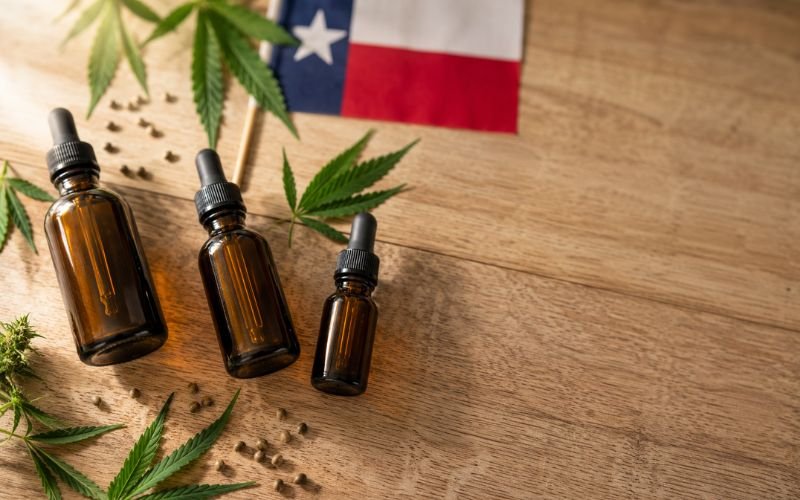
Yes—CBD is legal in Texas, but only under specific conditions. In general, CBD products derived from legally produced hemp containing no more than 0.3% delta-9 THC on a dry-weight basis are permitted under both federal law and Texas law. CBD products derived from marijuana, or products that exceed the legal THC limit, remain illegal except in limited circumstances under Texas medical cannabis laws.
For most consumers, the key legal question is not whether a product contains CBD, but where that CBD comes from and how much THC it contains.
Understanding the Confusion: Why Texas CBD Laws Aren’t Always Straightforward
Imagine you’re driving into Texas with a bottle of CBD oil you purchased legally in another state. The label says “full-spectrum hemp extract,” but it doesn’t clearly list the THC content or include a laboratory report. Is it legal to possess? Could law enforcement treat it as marijuana?
Questions like these are common because hemp, CBD, marijuana, Delta-8 THC, and Delta-9 THC are all related but regulated differently. Texas follows federal hemp standards in many respects, yet state enforcement, licensing rules, and the ongoing legal battles surrounding hemp-derived cannabinoids make the legal landscape more complicated than many consumers expect.
Understanding those distinctions can help you avoid unintentionally purchasing or possessing products that fall outside Texas law.
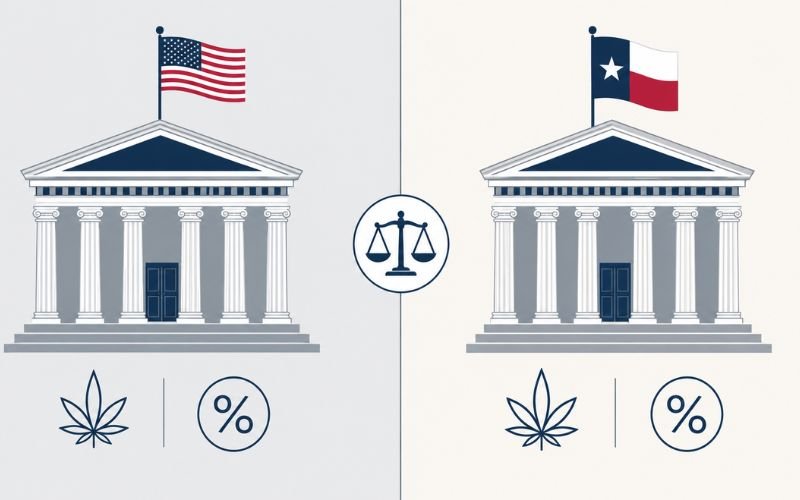
Federal Law vs. Texas Law
Federal Law: The 2018 Farm Bill
The modern legal framework for CBD begins with the Agriculture Improvement Act of 2018, commonly known as the 2018 Farm Bill.
This law removed hemp from the federal definition of marijuana under the Controlled Substances Act, provided that hemp contains no more than 0.3% delta-9 tetrahydrocannabinol (THC) on a dry-weight basis.
As a result:
- Hemp-derived CBD is generally legal under federal law.
- Marijuana-derived CBD remains federally illegal outside approved medical or research programs.
- States retain authority to regulate hemp production and retail sales within their borders.
Importantly, the Farm Bill did not legalize every CBD product. Products that exceed the federal THC threshold or violate other federal regulations may still be unlawful.
Texas Law
Texas adopted its own hemp framework after passage of the federal Farm Bill.
The state’s hemp program is primarily governed by:
- Texas Health and Safety Code Chapter 443
- [Texas Agriculture Code Chapter 121]
- Regulations administered by the Texas Department of State Health Services (DSHS) and the Texas Department of Agriculture, depending on the activity involved.
Texas generally permits hemp-derived CBD products that satisfy the state’s legal definition of hemp, including compliance with the 0.3% delta-9 THC limit measured on a dry-weight basis.
The state also regulates:
- manufacturing,
- distribution,
- processing,
- retail sales,
- labeling requirements, and
- product testing.
Businesses participating in the hemp industry typically must comply with state licensing or registration requirements depending on their role in the supply chain.
What Makes CBD Legal—or Illegal—in Texas?
The legality of CBD depends on more than the label.
Hemp-Derived CBD
CBD extracted from legally cultivated hemp is generally lawful when:
- it contains no more than 0.3% delta-9 THC (dry weight);
- it complies with Texas labeling and testing requirements;
- it is produced and sold under applicable state regulations.
This includes many:
- CBD oils
- capsules
- topical creams
- tinctures
- certain beverages
- gummies that comply with Texas law
Marijuana-Derived CBD
CBD extracted from marijuana remains a different legal category.
Even if two products contain identical amounts of CBD, the legal source matters.
Marijuana-derived CBD generally remains prohibited under Texas criminal law except through the state’s limited medical cannabis program.
Patients participating in the Texas Compassionate Use Program (CUP) may legally obtain qualifying cannabis products under program rules.
As of September 1, 2025, following the passage of House Bill 46, the program’s qualifying conditions expanded to include chronic pain, traumatic brain injury, Crohn’s disease, terminal illness, and hospice or palliative care—in addition to previously approved conditions such as epilepsy, PTSD, cancer, ALS, and multiple sclerosis. THC limits were also redefined, allowing up to 10 mg of THC per dose and 1 gram per package.
Retail Licensing Requirements
Texas regulates businesses that manufacture, distribute, process, or sell consumable hemp products.
Retailers generally must comply with applicable state registration or licensing requirements established by DSHS.
Consumers are not typically required to obtain any permit simply to purchase lawful hemp-derived CBD.
Are There Possession Limits?
Unlike marijuana laws, Texas generally does not establish a specific possession limit for lawful hemp-derived CBD products that comply with applicable laws.
However, possessing products that exceed legal THC limits could expose an individual to criminal investigation or prosecution depending on the circumstances.
Because THC concentration—not simply the product label—can determine legality, consumers should retain original packaging and laboratory documentation whenever possible.
Delta-8 vs. Delta-9 THC: Why This Causes So Much Confusion
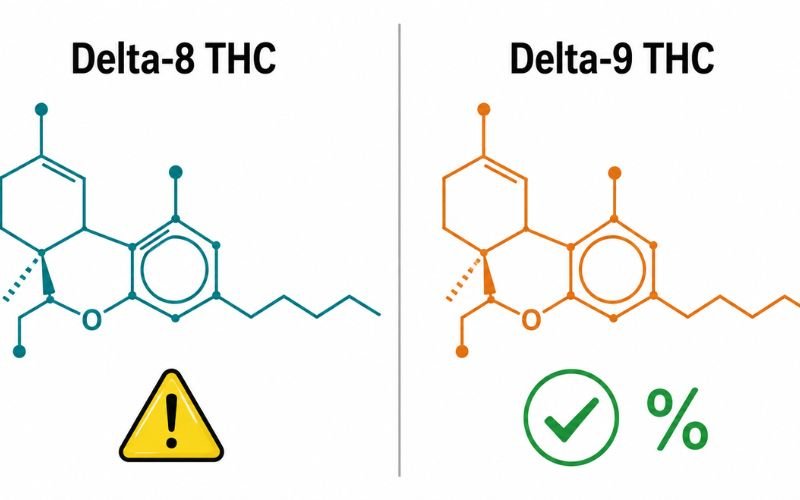
Delta-8 THC has become one of the most legally contested issues in Texas hemp law, and the rules changed significantly in 2026.
On May 1, 2026, the Texas Supreme Court ruled in DSHS v. Sky Marketing Corp. (No. 23-0887) that the Texas Department of State Health Services (DSHS) acted within its authority when it classified manufactured Delta-8 THC as a Schedule I controlled substance. The decision reversed a 2021 injunction that had allowed Delta-8 products to remain widely available in Texas retail stores for nearly five years.
The Court later issued a follow-up order making the ruling effective at 5:00 p.m. on May 28, 2026, giving Texas hemp retailers a deadline to bring their inventory into compliance.
What This Ruling Does and Does Not Cover
The ruling specifically applies to manufactured Delta-8 THC—meaning Delta-8 that is chemically converted from hemp-derived CBD, which describes the vast majority of commercially sold Delta-8 products. It does not apply to the trace amounts of Delta-8 that occur naturally in the hemp plant.
Other hemp-derived cannabinoids—including hemp products containing no more than 0.3% delta-9 THC, as well as THCA, HHC, and THCP—remain lawful in Texas, although several of these products are the subject of separate litigation or ongoing regulatory disputes.
Civil vs. Criminal Enforcement
One important distinction is that DSHS’s regulatory authority differs from criminal enforcement.
DSHS generally enforces its regulations through administrative or civil actions, while criminal prosecutions related to controlled substances are handled by local law enforcement agencies and county or district prosecutors under Texas criminal law. Consumers should not assume that a product’s regulatory status automatically determines whether criminal enforcement may occur.
Smokable Hemp Remains a Separate, Unsettled Issue
A related but separate regulation—25 Texas Administrative Code §300.101, effective March 31, 2026—defines compliant hemp using a combined delta-9 THC and THCA threshold of 0.3% on a dry-weight basis. The rule has been challenged in court and remains subject to ongoing litigation.
Looking Ahead: Federal Changes Coming in November 2026
Federal legislation scheduled to take effect on November 12, 2026, may redefine the federal definition of hemp in a way that excludes many consumable hemp products containing intoxicating THC. If implemented, these changes could significantly affect product availability nationwide, including in Texas.
Because this area of law is changing rapidly through legislation, agency rulemaking, and court decisions, consumers should treat Delta-8 products as a legally higher-risk category and avoid assuming a product is lawful simply because it is available for sale.
Where and How to Legally Buy CBD in Texas
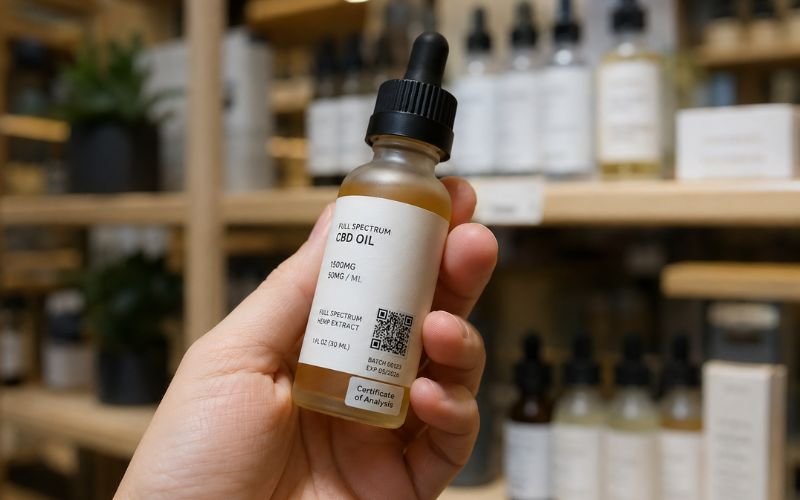
Consumers have many purchasing options, but not every CBD product is equally trustworthy.
Buying From Retail Stores
CBD products are commonly sold in:
- specialty CBD stores,
- wellness retailers,
- pharmacies,
- smoke shops,
- certain grocery stores.
Choose retailers that sell products from reputable manufacturers willing to provide independent laboratory testing.
Buying Online
Texas residents generally may purchase compliant hemp-derived CBD products online.
Before ordering, verify that the seller provides:
- current Certificates of Analysis (COAs);
- third-party laboratory testing;
- ingredient information;
- THC content;
- batch numbers.
Avoid websites that make unrealistic medical claims or fail to disclose laboratory testing.
What to Check Before Buying
A quality CBD product should clearly identify:
- hemp source;
- CBD concentration;
- THC concentration;
- manufacturer information;
- batch number;
- independent laboratory results;
- QR code linking to the Certificate of Analysis when available.
If this information is missing, consider purchasing another product.
Important: Vape and E-Cigarette Restrictions
Regardless of CBD’s general legality, Texas law separately restricts the sale of certain vape and e-cigarette products containing cannabinoids, including CBD.
This restriction was enacted through Senate Bill 2024 and makes prohibited sales a Class A misdemeanor. Unlike the ongoing litigation involving Delta-8 THC, this restriction is not currently subject to a court challenge.
Consumers should avoid purchasing CBD vape or e-cigarette products until they have confirmed that the product complies with current Texas law and applicable regulations.
Traveling With CBD in Texas and Across State Lines
Traveling within Texas with lawful hemp-derived CBD is generally less risky than carrying marijuana products, but caution is still appropriate.
Keep products:
- in their original packaging;
- accompanied by laboratory testing information if available;
- clearly labeled as hemp-derived.
If traveling across state lines, remember that every state regulates hemp products differently.
A product that is lawful in Texas may be restricted elsewhere, particularly if it contains Delta-8 THC or other hemp-derived intoxicating cannabinoids.
Air travelers should also review applicable Transportation Security Administration policies before flying.
Frequently Asked Questions
Is Delta-8 legal in Texas?
As of May 28, 2026, manufactured Delta-8 THC is classified by the Texas Department of State Health Services (DSHS) as a Schedule I controlled substance following a Texas Supreme Court decision.
DSHS generally enforces this classification through administrative or civil authority, while criminal enforcement depends on Texas criminal law and actions taken by local law enforcement and prosecutors.
Naturally occurring trace amounts of Delta-8 in hemp, along with hemp products containing lawful levels of delta-9 THC and certain other hemp-derived cannabinoids, remain subject to separate regulatory and legal developments.
Because this area of law continues to evolve, consumers should treat Delta-8 products as legally risky and avoid relying solely on product labels or retail availability when determining whether a product is lawful.
Do I need a prescription for CBD in Texas?
No.
Consumers generally do not need a prescription to purchase lawful hemp-derived CBD products that comply with Texas law.
Prescription requirements may apply only to certain cannabis products available through Texas’s medical cannabis program.
Can I travel with CBD products in Texas?
Generally yes, provided the products are lawful hemp-derived CBD containing no more than the legal THC limit.
Keeping products in their original packaging and retaining proof of laboratory testing may help avoid unnecessary confusion.
What’s the legal difference between CBD and marijuana?
CBD is a cannabinoid found in both hemp and marijuana.
Legally, the distinction usually depends on the source plant and THC concentration—not simply the presence of CBD itself.
Hemp-derived CBD within the legal THC limit is generally lawful.
Marijuana-derived CBD is generally prohibited outside limited medical exceptions.
Can I get arrested for possessing CBD in Texas?
Possessing lawful hemp-derived CBD is generally not a crime.
However, products that exceed legal THC limits or cannot readily be distinguished from illegal marijuana may create legal complications until their contents are verified.
Purchasing products from reputable companies that provide laboratory testing significantly reduces this risk.
Can employers prohibit CBD use?
Yes.
Even if CBD is legal under Texas law, employers may maintain workplace drug policies. Some CBD products contain trace THC that could potentially appear on certain drug tests.
Individuals subject to employment drug testing should carefully consider this possibility before using CBD products.
A Note on Legal Currency
Texas hemp and cannabinoid law is changing rapidly through litigation, agency rulemaking, and legislation. This article reflects the legal landscape as of June 30, 2026. Readers should verify current status through DSHS’s official website or a licensed Texas attorney before making purchasing decisions, especially regarding Delta-8 products.
Conclusion
For most Texans, the answer to the question “Is CBD legal in Texas?” is yes—but only when the product is derived from hemp and contains no more than 0.3% delta-9 THC on a dry-weight basis.
Consumers should look beyond marketing claims and verify that products comply with Texas requirements regarding THC content, labeling, and independent laboratory testing. The legal landscape surrounding hemp-derived cannabinoids—particularly Delta-8 THC—continues to evolve, making it important to stay informed about legislative and court developments before purchasing or using these products.
This article is provided for general informational purposes only and does not constitute legal advice. Hemp and cannabis laws can change through legislation, regulatory action, and court decisions. If you have questions about a specific legal situation, are facing criminal charges, or need advice about compliance with Texas hemp laws, consult a licensed Texas attorney who can evaluate your circumstances.