How to Get a Certified Translation for Legal Documents
A missing certification stamp, an incorrect translator’s declaration, or a document submitted in the wrong language for visa applications, court proceedings or immigration petitions can result in delays or rejections.
Yet many people in these situations do not know what a certified translation is or how to get one. This guide explains what a certified translation means, when different authorities require it and what to check before you submit.
What Does Certified Translation Mean?
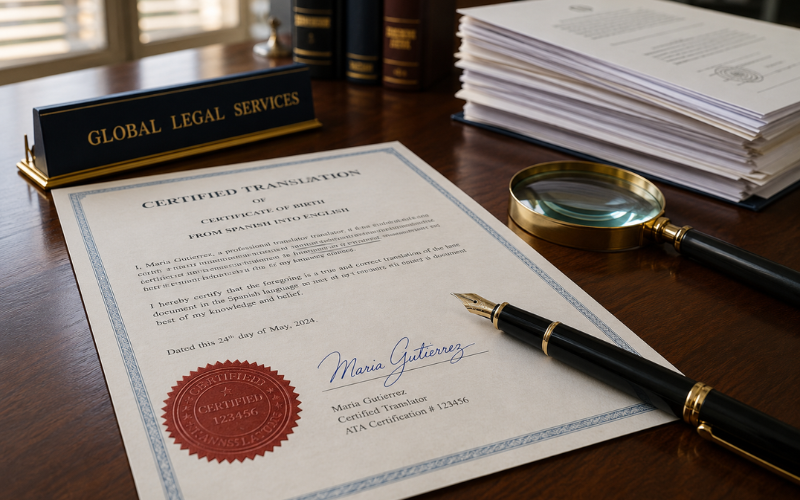
A certified translation is a translation that includes a signed statement from the translator or translation agency, confirming that the translation is true and complete to the best of their knowledge. This statement is also called Certificate of Accuracy, or a translator’s declaration, and must include the translator’s name, contact information, and signature.
Certified vs. notarized vs. apostilled
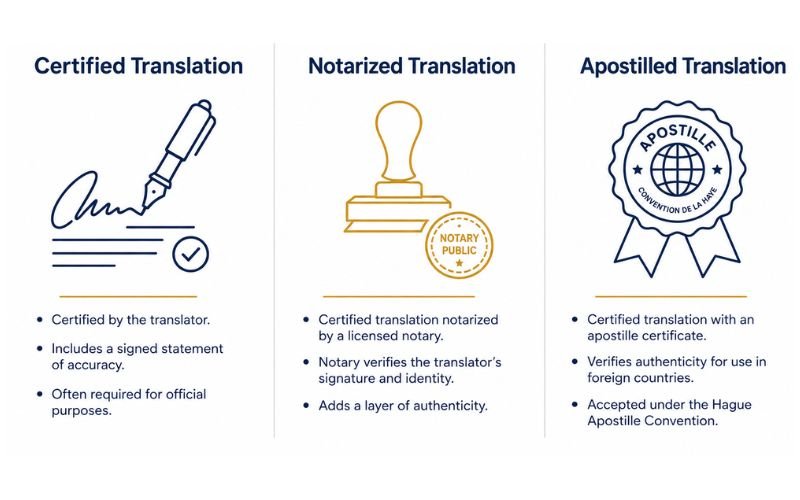
These three terms are used interchangeably, but they mean different things and have different legal significance.
- Certified translation: This includes a certification statement by the translator or translation agency, attesting to the completeness and accuracy of the translation. The translator does not need to be sworn by any court in the country of use.
- Notarized translation: This is a translated document that includes the notary stamp. The notary public acts as the witness, confirming the identity of the translator who produced the document. It is commonly required by courts and universities.
- Apostilled translation: This is a translation that includes an apostille, an internationally recognised authentication issued under the Hague Convention. It is required when submitting foreign documents in member countries.
The authority or court receiving your documents will specify exactly which form they require. Read those instructions carefully before ordering a translation.
When You Need a Certified Translation
Not every translated document requires certification. A translated contract for personal reference does not. But for any of the following, you’ll need a certified translation:
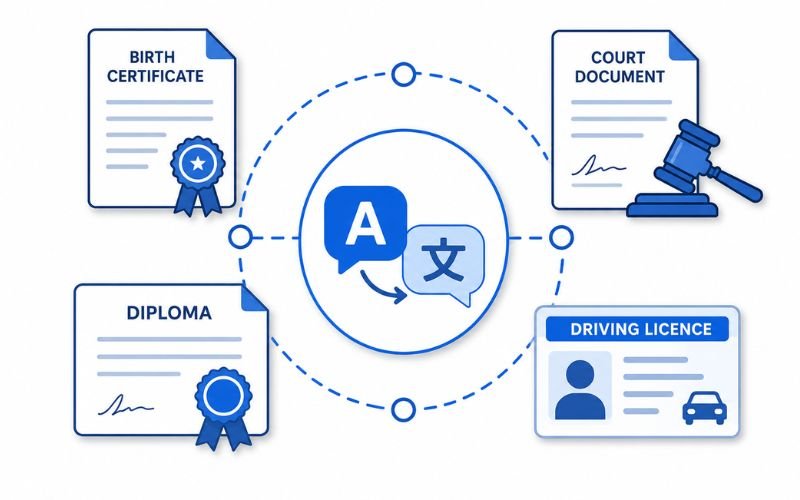
Immigration and visa applications
U.S. Citizenship and Immigration Services (USCIS) requires that “any document containing foreign language submitted to USCIS shall be accompanied by a full English translation that the translator has certified as complete and accurate, and by the translator’s certification that he or she is competent to translate from the foreign language into English.” This covers birth certificates, marriage and divorce certificates, police clearance letters, academic transcripts, and financial statements.
The same standard applies, with minor variations, to UK Visas and Immigration (UKVI), Immigration, Refugees and Citizenship Canada (IRCC), and equivalent agencies in Australia and across the EU.
Court filings and legal proceedings
When foreign-language documents are entered as evidence or submitted as part of a legal filing, courts expect translations that can withstand scrutiny. In federal courts and most state courts in the United States, the translation must be certified and, depending on the jurisdiction, the translator may be subject to cross-examination.
Translated contracts, foreign judgments, and witness statements are among the documents most commonly requiring certified translation in commercial and civil litigation.
Citizenship and naturalization
Naturalization applications frequently involve documents spanning decades, including birth records, educational certificates, military records, some of which may be written in languages the applicant no longer actively uses. Every supporting foreign-language document submitted with a naturalisation petition typically requires a certified translation.
Driving licences and professional credential recognition
Authorities that evaluate foreign qualifications or licences,whether state licensing boards, medical councils, or equivalency assessment bodies, typically require certified translations of academic records and professional certificates before they can process an application.
Who Can Provide a Certified Translation?
This depends on the country and the authority receiving the document.
1. United States (USCIS standard)
USCIS does not require translators to hold a specific credential. The translator must certify that they are competent in both languages and that the translation is accurate. There is no requirement for the translator to be a member of any professional body. However, USCIS can issue rejections due to translation errors. So, it’s better to work with a professional translation service that routinely handles immigration documents to reduce risks.
2. United Kingdom (UKVI)
UKVI recommends that translations be provided by a professional translator or translation agency. The Home Office has historically favoured translations from members of the Chartered Institute of Linguists (CIOL) or the Institute of Translation and Interpreting (ITI), and some solicitors advise using only these sources to reduce the risk of challenge.
3. EU member states and other jurisdictions
Several EU countries such as Germany, France, Spain, and Portugal among them, require sworn translations (traductions assermentées or beglaubigte Übersetzungen), which must be produced by a court-appointed or sworn translator. A standard certified translation from a general translation agency will not be accepted in these contexts. If you are submitting documents in any EU jurisdiction, verify the specific requirement rather than assuming certification is uniform.
How to Get a Certified Translation: Step by Step
Step 1: Identify the Exact Requirement
Before engaging a translator, read the instructions from the receiving authority in full. Note whether they require certification, notarization, or an apostille, and whether the translator must hold a specific credential or be registered with a professional body.
Step 2: Prepare and Submit Your Source Documents
Provide clear, legible copies of the original documents. For handwritten records, aged documents, or those with official seals, a scan at 300 DPI or higher is generally sufficient. Let the translator know upfront if the original is difficult to read.
Step 3: Work With a Qualified Translator or Agency
For immigration and court documents, you should work with professional translation services that specialize in legal and official documents. Make sure the certified translation includes the translator’s full name, contact details, signature, and date.
Step 4: Review the Completed Translation
Even if you are not fluent in the target language, you can check several things: Does the translated document contain all sections of the original? Are names, dates, and document numbers reproduced exactly? Is the certification statement present and complete? If anything looks inconsistent, query it before submission.
Step 5: Submit Within the Required Timeframe
Some authorities specify that translations must be recent. Check whether your translation needs to be dated within a specific window of your application.
Common Reasons Certified Translations Are Rejected
Understanding the cause of rejection is as useful as understanding the requirements themselves. The most common problems are:
- Missing or incomplete certification statement
- Partial translations, only certain sections of a multi-page document are translated
- Errors in transliterating names or dates that do not match other submitted documents
- Translation produced by a family member or the applicant themselves
- Wrong type of authentication, submitting a notarized translation where a sworn translation is required.
Where the translation requirement is ambiguous, contact the receiving authority before submitting rather than making assumptions.
A Note on AI and Machine Translation
Machine translation quality has improved significantly, but no AI system currently meets the certification standard on its own. Certification requires a named human who takes responsibility for the accuracy of the translation.
That said, AI-powered tools can still play a valuable role in the translation process. Tools, like Cipher, preserve the original formatting, layout, tables, and document structure, reducing the amount of manual formatting work required after translation.
Do not submit raw machine translations for legal documents. Immigration officers and courts are familiar with the patterns of machine error, and an uncertified machine translation is likely to result in a request for evidence or outright rejection.