Why Five Supreme Court Justices Recused Themselves in Baker v. Coates
When people think of the U.S. Supreme Court, they usually picture all nine justices hearing major cases and issuing decisions that shape American law. That’s why many were surprised when news broke that **five Supreme Court justices did not participate in Baker v. Coates, an exceptionally rare situation that prevented the Court from hearing the case at all.
The event quickly attracted attention because it wasn’t just about judicial ethics. It also highlighted an important procedural rule that many people have never heard of: the Supreme Court cannot conduct business unless a minimum number of justices are available to participate.
For lawyers and legal scholars, the case was a reminder that ethics rules can directly affect how the nation’s highest court functions. For everyone else, it raised simple but important questions:
- Why would so many justices step aside from the same case?
- What happens when the Supreme Court doesn’t have enough justices to hear an appeal?
- Does this mean the lower court’s decision automatically stands?
This article explains what happened in Baker v. Coates, why five justices recused themselves, how the Supreme Court’s quorum rule works, and why this unusual event matters.
What Happened in Baker v. Coates?
In 2025, the Supreme Court was asked to review Baker v. Coates, a case involving publishing-related parties, including companies connected with Penguin Random House.
However, before the Court could consider the appeal, an unusual situation developed.
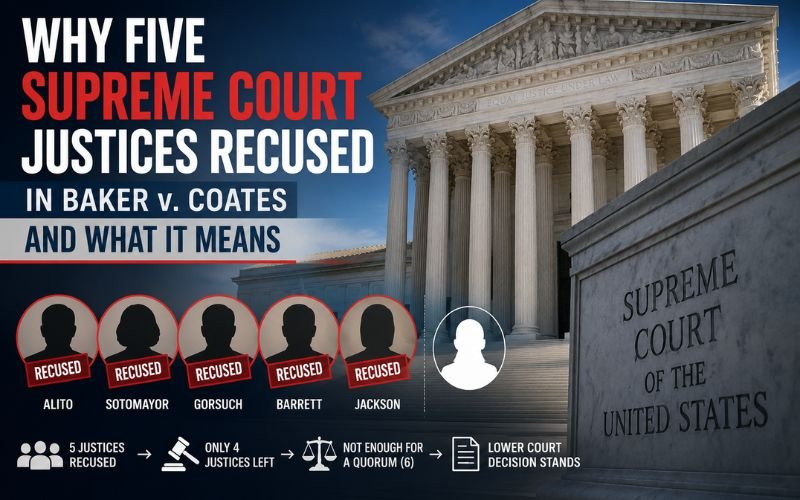
The Supreme Court’s official order showed that Justices Samuel Alito, Sonia Sotomayor, Neil Gorsuch, Amy Coney Barrett, and Ketanji Brown Jackson did not participate in the case.
That left only four justices available.
Because federal law requires at least six justices to form a quorum, the Court was legally unable to hear the appeal. As a result, the Supreme Court did not issue an opinion on the merits of the case, and the judgment of the lower court remained in effect.
Although multiple news organizations reported that several recusals were likely connected to publishing relationships involving Penguin Random House’s parent company, the Supreme Court did not officially explain the reasons for each justice’s decision to step aside. That is consistent with the Court’s long-standing practice, as justices are generally not required to provide detailed explanations for recusals.
What Does It Mean When a Justice Recuses Themselves?
A recusal occurs when a judge or justice decides not to participate in a case because doing so could create a conflict of interest or raise reasonable questions about impartiality.
When a justice recuses themselves, they do not
- Review the case materials.
- Take part in private discussions.
- Hear oral arguments.
- Vote on the final decision.
Recusal is intended to protect the fairness and credibility of the judicial process rather than suggest wrongdoing.
Why Do Supreme Court Justices Recuse Themselves?
Every justice has a responsibility to avoid participating in cases where their impartiality could reasonably be questioned.
Some common reasons include:
Financial Interests
If a justice owns stock or has another financial interest connected to a party in the case, recusal may be appropriate.
Previous Legal Involvement
A justice who worked on the same case while serving as a lower-court judge or government attorney will often step aside after joining the Supreme Court.
Family or Personal Relationships
If a close family member is involved in litigation or another personal relationship creates a potential conflict, recusal helps preserve public confidence in the court.
Other Ethical Considerations
Sometimes the circumstances are unique. Even if a conflict is not explicitly prohibited by law, a justice may conclude that participating could create the appearance of bias.
Why Was Baker v. Coates So Unusual?
Individual recusals happen from time to time.
Multiple recusals in the same case are much less common.
Having five of the nine justices recuse themselves is exceptionally rare because it affects not only who decides the case but also whether the Court can hear it at all.
Unlike lower courts, the Supreme Court has only nine members. There are no substitute justices who can fill in when someone steps aside.
That means a large number of recusals can temporarily prevent the court from exercising its authority over a particular case.
The Supreme Court’s Six-Justice Quorum Rule
One of the biggest misconceptions is that the remaining justices can simply decide a case regardless of how many members participate.
In reality, federal law sets a minimum participation requirement.
Under 28 U.S.C. § 1, six justices constitute a quorum for the Supreme Court.
A quorum is the minimum number of members required for the Court to conduct its official business.
Because five justices recused themselves in Baker v. Coates, only four justices remained.
Since four is fewer than the required six, the Court lacked the legal authority to hear the appeal.
This procedural rule—not the merits of the case—prevented the Supreme Court from moving forward.
What Happens When the Supreme Court Lacks a Quorum?
Many people assume that if the Supreme Court cannot hear a case, it simply waits until later.
That is not always possible.
When the Court lacks a quorum and postponement is not practical, federal law provides a solution.
In Baker v. Coates, the lower court’s judgment remained in place because the Supreme Court could not review the appeal.
Importantly, this does not mean the Supreme Court agreed with the lower court’s reasoning.
Instead, it means the Court was unable to consider the case because it lacked enough participating justices.
This distinction is important because the Supreme Court did not create a new nationwide legal precedent through this case.
Why Doesn’t the Supreme Court Explain Every Recusal?
Unlike many court decisions, recusal decisions are usually brief.
The Supreme Court often announces only that a justice “took no part” in a case.
The Court generally does not publish detailed explanations unless a justice chooses to write separately.
Because of this practice, outside observers sometimes rely on publicly available financial disclosures, ethics rules, and the facts of the case to understand why recusals may have occurred.
However, unless the Court or an individual justice provides an official explanation, those reasons remain an informed analysis rather than confirmed facts.
Why Judicial Ethics Matter
The Supreme Court has no higher court reviewing its decisions.
That makes public confidence especially important.
Judicial ethics are designed to ensure that cases are decided based on the law rather than personal interests.
When a justice believes their participation could create even the appearance of a conflict, recusal helps protect the integrity of the Court.
Although recusals can sometimes delay or even prevent review of a case, they also reinforce the principle that justice should be impartial.
For many legal experts, maintaining trust in the judicial system is more important than ensuring every justice participates in every case.
Why This Case Received So Much Attention
The events in Baker v. Coates attracted national attention for several reasons.
First, it is uncommon for so many Supreme Court justices to recuse themselves from a single case.
Second, the recusals triggered the Court’s quorum rule, making it impossible to hear the appeal.
Finally, the case sparked broader discussions about judicial ethics, financial disclosures, transparency, and how potential conflicts of interest should be handled at the highest level of the federal judiciary.
While the legal issues in the underlying dispute were important, much of the public conversation focused on how the court functions when multiple justices cannot participate.
What Can We Learn from Baker v. Coates?
For most people, Baker v. Coates is less about the underlying lawsuit and more about building everyday legal awareness and understanding how the Supreme Court operates.
The case demonstrates the following:
- Judicial ethics can directly affect court proceedings.
- Supreme Court justices sometimes recuse themselves to avoid potential conflicts.
- Federal law requires at least six justices for the Court to conduct business.
- Without a quorum, the Supreme Court cannot hear certain appeals.
- A lower court’s ruling may remain in effect even though the Supreme Court never considers the merits of the case.
These rules help balance two important goals: ensuring fairness in judicial decision-making and maintaining public confidence in the legal system.
Conclusion
The decision of five Supreme Court justices to step aside in Baker v. Coates was an unusual event that highlighted both judicial ethics and the Court’s procedural rules.
Because only four justices remained, the Supreme Court lacked the six-member quorum required by federal law and could not hear the appeal. As a result, the lower court’s judgment remained in place without the Supreme Court ruling on the substance of the dispute.
Although the Court did not publicly explain each recusal, the case has become an important example of how ethics and court procedures can influence the administration of justice. It also reminds us that the Supreme Court’s role is shaped not only by the Constitution but also by rules designed to preserve fairness, impartiality, and public trust.
Frequently Asked Questions
Why did five Supreme Court justices recuse themselves in Baker v. Coates?
The Supreme Court’s order confirmed that five justices did not participate, but it did not officially explain the reason for each recusal. Legal observers have pointed to potential conflicts involving publishing relationships, but the court itself did not provide detailed explanations.
What is a judicial recusal?
A judicial recusal occurs when a judge or justice chooses not to participate in a case because of a potential conflict of interest or concerns about impartiality.
What is a quorum in the Supreme Court?
A quorum is the minimum number of justices required for the Supreme Court to conduct official business. Under 28 U.S.C. § 1, the Court generally needs six justices to form a quorum.
What happened because the Court lacked a quorum?
Since only four justices remained after the recusals, the Supreme Court could not hear the appeal. The lower court’s judgment therefore remained in effect under federal law.
Does a recusal mean a justice did something wrong?
No. A recusal is generally considered an ethical safeguard. It helps ensure that court decisions are made fairly and without actual or perceived conflicts of interest.
Will this situation happen often?
No. Individual recusals occur from time to time, but having five justices recuse themselves from the same case is extremely rare. That is one reason Baker v. Coates attracted significant public attention.