A Beginner’s Guide to Reverse Discrimination and the Supreme Court
Introduction
The topic of supreme court reverse discrimination has become one of the most discussed legal issues in the United States. News stories about college admissions, workplace diversity programs, and Supreme Court rulings have made many people curious about what reverse discrimination actually means.
For beginners, the subject can feel confusing because it involves civil rights laws, constitutional protections, and court decisions that affect schools, businesses, and government agencies. Some people believe diversity-focused policies help create equal opportunities, while others believe such policies can unfairly disadvantage certain groups.
The Supreme Court plays a major role in deciding how discrimination laws apply to everyone. Its rulings shape policies related to education, hiring, promotions, scholarships, and workplace practices across the country.
This guide explains reverse discrimination in simple language, covers important Supreme Court cases, explains how workplace claims are handled, and explores why this issue remains highly debated today.
What Is Reverse Discrimination?
Reverse discrimination is a term used when a person from a majority or historically advantaged group claims they were treated unfairly because of race, gender, or another protected characteristic.
In simple words, it usually refers to situations where someone believes a diversity-related policy harmed their chances of getting a job, promotion, school admission, or other opportunity.
Common Examples
Here are a few examples:
- A white student claims they were denied admission because race was considered in the admissions process.
- A male employee argues a promotion was given mainly to improve gender diversity.
- A worker believes company hiring policies unfairly favored minority applicants.
Even though the phrase “reverse discrimination” is widely used in public discussions, U.S. law generally treats these cases as regular discrimination claims under existing civil rights laws.
Why the Supreme Court Matters
The Supreme Court is the highest court in the United States. It has the final authority to interpret the Constitution and federal laws.
When lower courts disagree about discrimination laws, the Supreme Court may step in and issue a final ruling. These decisions can affect:
- College admissions policies
- Workplace diversity programs
- Government contracting
- Scholarship programs
- Hiring and promotion practices
Because of this, Supreme Court rulings often influence policies nationwide.
Laws Behind Reverse Discrimination Cases
To understand supreme court reverse discrimination cases, it helps to know the major laws involved.
The Equal Protection Clause
The Equal Protection Clause is part of the Fourteenth Amendment to the U.S. Constitution.
It says states must provide equal protection under the law to all people.
Courts use this clause when reviewing policies that treat people differently based on race or gender.
Example
If a public university gives preference to applicants based on race, the policy may be challenged under the Equal Protection Clause.
Title VII of the Civil Rights Act
Another important law is Title VII of the Civil Rights Act of 1964.
This federal law prohibits workplace discrimination based on:
- Race
- Color
- Religion
- Sex
- National origin
The law protects everyone, including both minority and majority groups.
Example
If a company refuses to hire someone because they are white or male, that person may still have legal protection under Title VII.
Recent Trends and Public Opinion
The debate around reverse discrimination has grown in recent years, especially after major Supreme Court rulings involving affirmative action and diversity programs.
According to reports from the Equal Employment Opportunity Commission (EEOC), thousands of workplace discrimination complaints related to race and hiring practices continue to be filed each year.
Legal experts have also noticed an increase in lawsuits challenging diversity, equity, and inclusion (DEI) initiatives after recent Supreme Court decisions.
Public opinion remains divided.
What Surveys Show
Research organizations such as Gallup and Pew Research have found mixed opinions among Americans regarding affirmative action and race-conscious policies.
Some people believe these policies help address historical inequality and improve representation.
Others believe hiring and admissions decisions should be completely race-neutral and based only on qualifications or merit.
These different viewpoints continue shaping legal debates and future lawsuits.
Understanding Affirmative Action
Affirmative action is closely connected to discussions about reverse discrimination.
Affirmative action refers to policies designed to increase opportunities for historically underrepresented groups.
These policies may appear in:
- College admissions
- Hiring programs
- Government contracting
- Scholarships
Supporters say affirmative action helps address historical discrimination and improves diversity.
Critics argue it may unfairly disadvantage individuals from majority groups.
Because of this debate, affirmative action has been challenged many times in court.
How the Supreme Court Reviews Reverse Discrimination Cases
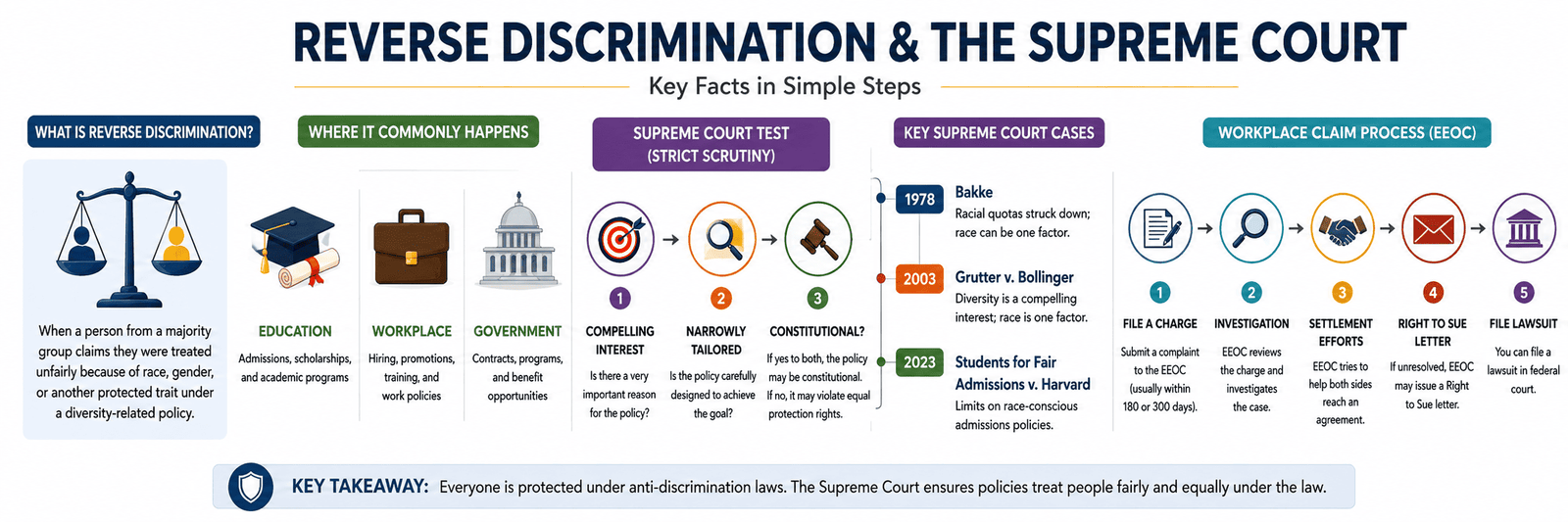
When the Supreme Court reviews discrimination cases involving race-based policies, it often uses a legal standard called “strict scrutiny.”
This is one of the toughest legal tests in constitutional law.
How the Strict Scrutiny Test Works
The strict scrutiny test helps the Court decide whether a race-based policy is constitutional.
Here is a simple breakdown:
Government Uses Race-Based Policy
↓
Does the Government Have a Compelling Reason?
↓
Is the Policy Narrowly Tailored?
↓
If BOTH answers are YES → Policy may survive
If NOT → Policy may be unconstitutional
Simple Example
Imagine a university wants to improve campus diversity.
The Supreme Court may ask:
- Is diversity an important enough goal?
- Is the admissions policy carefully designed?
- Could the same goal be achieved without considering race?
If the Court believes the policy is too broad or unfair, it may rule against the university.
Major Supreme Court Reverse Discrimination Cases
Regents of the University of California v. Bakke (1978)
This was one of the earliest major affirmative action cases.
A medical school reserved seats for minority applicants. Allan Bakke, a white applicant, claimed the system discriminated against him.
Supreme Court Decision
The Court ruled that strict racial quotas were unconstitutional.
However, it also said race could still be considered as one factor in admissions decisions.
This case shaped affirmative action policies for many years.
Grutter v. Bollinger (2003)
This case involved the University of Michigan Law School.
The school considered race during admissions to promote diversity.
Supreme Court Decision
The Court ruled that diversity in higher education could be a compelling interest.
However, race could not be the only deciding factor.
The ruling allowed limited race-conscious admissions policies.
Students for Fair Admissions v. Harvard (2023)
This became one of the most important recent Supreme Court cases involving reverse discrimination and affirmative action.
The lawsuit argued Harvard’s admissions process unfairly disadvantaged certain applicants because of race.
Supreme Court Decision
The Court limited the use of race-conscious admissions policies and ruled that many existing practices violated the Equal Protection Clause.
The decision significantly changed how colleges approach admissions nationwide.
Reverse Discrimination in the Workplace
Workplace discrimination claims are another major area where reverse discrimination issues appear.
Some employers create diversity initiatives aimed at improving representation in leadership and hiring.
However, these programs can sometimes lead to lawsuits if employees believe decisions were based too heavily on race or gender.
The Role of the EEOC in Workplace Cases
The EEOC plays an important role in workplace discrimination cases and tracks yearly charge statistics across the country.
Before many employees can file a discrimination lawsuit in court, they must first submit a complaint to the EEOC.
This complaint is called a “Charge of Discrimination.”
What the EEOC Does
The EEOC may:
- Review discrimination complaints
- Investigate employer actions
- Request company records
- Interview witnesses
- Encourage settlements
- Issue a “Right to Sue” letter
The agency plays an important role in workplace discrimination cases.
Example of a Workplace Reverse Discrimination Claim
Imagine an employee believes they were denied a promotion because their employer wanted to meet diversity goals.
The employee may:
- File a complaint with the EEOC
- Provide evidence such as emails or evaluations
- Participate in an investigation
- Receive permission to file a lawsuit if needed
The courts then decide whether unlawful discrimination occurred.
Important Filing Deadlines
Employment discrimination complaints often have strict deadlines.
In many cases, workers must file an EEOC complaint within a limited number of days after the alleged discrimination happened.
Missing deadlines can affect the ability to pursue legal action.
Because employment law can be complex, many people choose to consult an attorney before filing a claim.
Why Reverse Discrimination Cases Are Controversial
These cases remain controversial because they involve competing ideas about fairness and equality.
Arguments Supporting Diversity Policies
Supporters believe diversity-focused policies can:
- Address historical discrimination
- Improve educational environments
- Create broader representation
- Increase opportunities for underrepresented groups
Many organizations argue diversity benefits schools and workplaces.
Arguments Against Reverse Discrimination
Critics believe some diversity policies may:
- Treat individuals unfairly because of race
- Ignore merit and qualifications
- Create new forms of discrimination
- Conflict with equal protection principles
They argue decisions should focus entirely on individual achievement.
How These Cases Affect Everyday Life
Supreme Court decisions involving reverse discrimination can influence many parts of society.
Students
College admissions rules may change after major court rulings.
Schools may revise scholarship programs and application procedures.
Employees
Employers often review hiring and promotion policies to ensure they comply with discrimination laws.
Human resources departments may adjust diversity initiatives after important Supreme Court decisions.
Businesses and Universities
Organizations frequently seek legal advice to avoid discrimination lawsuits while still promoting diversity goals.
Common Misunderstandings About Reverse Discrimination
Myth 1: Reverse Discrimination Is a Separate Law
There is no separate federal law specifically called “reverse discrimination law.”
Courts generally treat these cases under existing anti-discrimination laws.
Myth 2: Diversity Programs Are Always Illegal
Not all diversity programs are unlawful.
Courts examine whether policies follow constitutional standards and anti-discrimination laws.
Myth 3: The Supreme Court Completely Ended Affirmative Action
The Supreme Court has limited some race-conscious policies, especially in college admissions.
However, schools and employers may still pursue diversity through legally acceptable methods.
The Future of Supreme Court Reverse Discrimination Cases
Legal experts expect more lawsuits involving:
- College admissions
- Workplace diversity programs
- Scholarships
- Government contracts
- Hiring practices
As society changes, courts will continue interpreting how discrimination laws apply in modern situations.
Technology may also create new legal challenges. For example, AI hiring systems and automated screening tools could raise future discrimination concerns.
Tips for Understanding Legal News
Legal topics can sometimes feel overwhelming. Here are a few simple tips for beginners.
Read Beyond Headlines
News headlines often simplify complex legal decisions.
Reading full summaries can provide better understanding.
Understand the Difference Between Law and Policy
A company policy is not always legally required.
The Supreme Court focuses on whether policies violate constitutional or federal law.
Know That Laws Can Evolve
Court interpretations may change over time as new legal arguments and social issues emerge.
Conclusion
The issue of supreme court reverse discrimination continues shaping legal and public debates across the United States.
At the center of these cases is one major question: how can laws ensure fairness and equal treatment for everyone?
Some people believe diversity-focused policies are necessary to address historical inequality and improve representation. Others believe race-neutral systems are the fairest approach.
The Supreme Court plays a critical role in balancing these competing views. Its decisions affect education, employment, government programs, and workplace practices nationwide.
For beginners, understanding the basic legal principles behind reverse discrimination can make complex legal discussions easier to follow. As new lawsuits continue emerging, this topic will likely remain important for years to come.
FAQs
What is reverse discrimination?
Reverse discrimination refers to claims that someone from a majority group experienced unfair treatment because of race, gender, or another protected characteristic.
Does the Supreme Court recognize reverse discrimination?
The Supreme Court generally examines whether unlawful discrimination occurred under existing laws rather than treating reverse discrimination as a separate category.
What is affirmative action?
Affirmative action refers to policies designed to increase opportunities for historically underrepresented groups.
What does the EEOC do?
The EEOC investigates workplace discrimination complaints and enforces federal employment discrimination laws.
Can white employees file discrimination claims?
Yes. Federal anti-discrimination laws protect all workers regardless of race or background.
Why are college admissions cases important?
These cases influence how universities may legally consider race during admissions decisions.
Are diversity programs illegal?
Not necessarily. Courts review whether such programs comply with constitutional and federal anti-discrimination laws.
Why do Supreme Court discrimination cases matter?
These rulings affect schools, workplaces, hiring practices, scholarships, and government programs across the country.