What is the Difference Between a Copyright and a trademark, and a Patent?
When you invest significant time and capital into a new venture, you want to prevent your competitors from misappropriating your work. Many people use the terms copyright, trademark, and patent interchangeably. However, each of these terms has specific legal protections and boundaries.
You may misidentify your intellectual property and make filing errors, leaving your most valuable assets vulnerable to infringements. This guide breaks down these forms of protection to help you apply for the right protection.
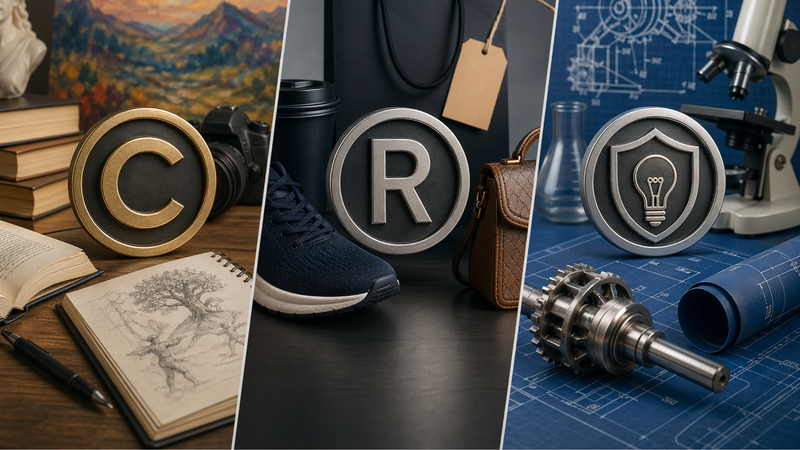
Copyright: Protecting Your Expression
A copyright protects the original work of authorship. You need copyright to protect your expression of an idea, not the idea itself. For example, you cannot copyright the concept of a “detective novel,” but you can copyright the specific words and chapters you wrote to tell that story.
Your work can be in written or recorded form, or it can be captured in a way that can be perceived or reproduced.
Copyright protection covers:
- Literary works such as books, articles, and even technical manuals.
- Digital content such as source code and website copy
- Media such as paintings, sculptures, and even architectural blueprints
Copyright provides long-term protection:
- The entire life of the author plus an additional 70 years
- For content created by an employee for a company, 95 years from publication or 120 years from creation, whichever is shorter
It is important to understand the difference between protection and enforcement. While you own the copyright the moment you create your work, you must register it if you want to file an infringement lawsuit. You are not eligible for statutory damages without a formal registration.
Trademark: Protecting Your Brand Identity
The primary legal purpose of trademarks is source identification. The goal is to ensure that your customers can recognize your brand after seeing your specific mark.
A trademark covers almost any unique identifier that distinguishes your brand in the market.
These identifiers include:
- Business names such as Apple
- Logos such as the Nike Swoosh
- Catchy slogans such as Just Do It
- Trade dress, such as packaging
- Non-traditional marks such as sounds (the Netflix “ta-dum”)
The trademark law considers the likelihood of confusion. A trademark provides you with the right to prevent others from using similar identifiers to trick a customer.
For example, if your business is selling “Kool” sneakers, the USPTO will block your competitors from selling “Cool” sneakers. While “Cool” and “Kool” have different spellings, the sound can confuse customers.
A trademark does not expire like a patent or copyright. However, you must meet the following conditions:
- Under Section 45 of the Lanham Act, if you fail to use the mark for three consecutive years, it is legally presumed to be abandoned.
- You must file a Section 9 renewal application and a Section 8 declaration of use every 10 years.
- If you allow others to use similar names without challenge, you will lose your exclusive rights through genericide. For example, Escalator lost its trademark status in 1950 as it became the common, generic name for moving staircases.
Patent: Protecting Your Innovation
A patent is a legal contract between you and the government, allowing you to prevent others from making, using, or selling your invention. It protects the functional and technical aspects of your invention.
A patent covers the following four categories:
- Processes such as a new way to manufacture biodegradable plastic
- Machines such as a new surgical tool
- Manufactured items, such as a specialized glass for smartphone screens
- Compositions of matter, such as metal alloys or new pharmaceuticals
Your invention must meet the following three strict legal standards to qualify for a patent:
1. Novelty
It must be a new invention.
2. Non-Obviousness
It cannot be a simple “obvious” tweak to something that already exists.
3. Usefulness
It must have a practical, real-world application.
However, once your patent expires, you must publicly disclose exactly how your invention works. The goal is to allow future inventors to build upon your work and advance technology.
Duration of Protection
| Patent Category | Duration (years) |
| Utility Patents | 20 |
| Design Patents | 15 |
Conclusion
You must understand the boundaries of copyrights, trademarks, and patents to get the right legal protection for your asset. Misidentification of assets and asset protection not only leads to costly filing errors but also leaves your assets vulnerable. You can rely on professionals offering copyright and trademark services to ensure accurate filing.